
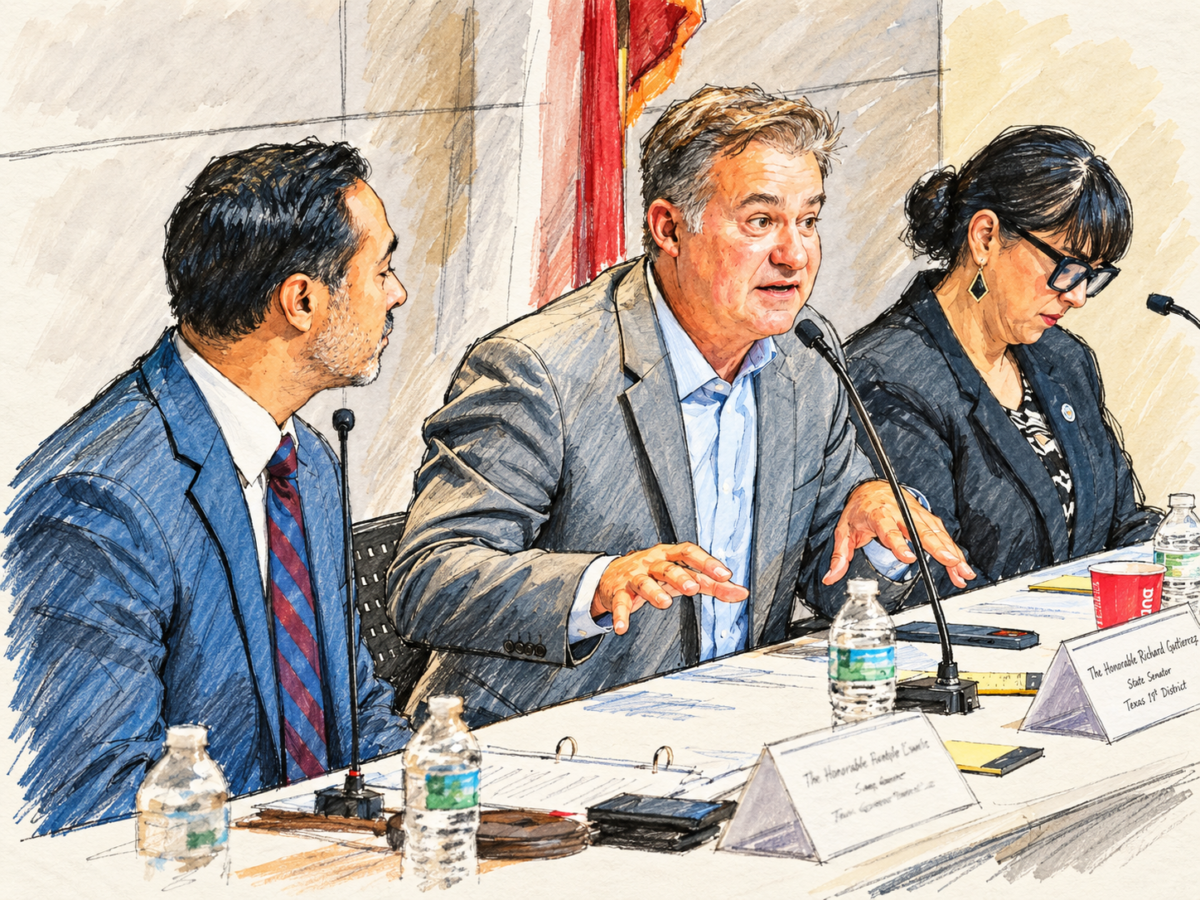
A community meeting organized by Democratic U.S. Rep. Joaquin Castro’s office brought together local elected officials, clergy and immigration advocates Friday to criticize stepped-up federal immigration enforcement and oppose plans for a large Immigration and Customs Enforcement detention facility on San Antonio’s East Side.
More than 150 people attended the event at the San Antonio Central Library, with others watching online. Organizers titled the meeting “Examining the Community Impacts of Mass Deportation and Proposed ICE Warehouse.”
COPS/Metro Alliance, a coalition of congregations, public schools, labor unions and nonprofit organizations that describes itself as nonpartisan, proposed the meeting to Castro’s office and helped organize attendance. Many of those present were affiliated with the organization.
The speakers presented an overwhelmingly critical view of ICE enforcement and the Trump administration’s immigration policies. The elected officials quoted in coverage of the event — including Castro, Mayor Gina Ortiz Jones, state Rep. Barbara Gervin-Hawkins and state Sen. Roland Gutierrez — are Democrats, and the meeting did not feature a comparable group of speakers defending the administration’s enforcement policy or the proposed facility.
The Rev. Jimmy Drennan, pastor of St. Margaret Mary Catholic Church, described several families he said had been harmed by immigration enforcement. One account involved a 4-year-old girl who repeatedly called her detained father’s phone to hear his recorded voice.
Neither Drennan nor the original report identified the father or provided his immigration status, criminal history, any prior removal history, or the government’s stated basis for detaining him. Those details therefore could not be independently established from the anecdote as presented.
Drennan also described a parishioner who was eight months pregnant when immigration agents detained her husband. Again, the couple was not identified in the report, and it did not establish whether the woman was a U.S. citizen or lawful immigrant, her husband’s immigration status, whether he had a criminal record, or whether a removal order was involved. Without identifying information, those questions remain unresolved.
A separate San Antonio detention case publicly highlighted by Castro shows why those distinctions can matter. Castro has advocated for the release of Octavio Daniel Cabrera Valdez, a father of an 8-year-old son and a 4-year-old daughter. It has not been established that Cabrera Valdez is the father Drennan referenced at Friday’s meeting.
According to Texas Tribune reporting, Cabrera Valdez, his wife and son entered the United States legally as tourists in 2020 but stayed after their visas expired. He later applied for a green card through his U.S.-citizen mother. The Tribune reported that a review of immigration, state and federal court records found no criminal conviction in his case.
Castro has emphasized that Cabrera Valdez held a valid work permit when he was detained. ICE told KSAT that Cabrera Valdez was taken into custody after an April arrest by the Stockdale Marshal’s Office and that an immigration judge later denied him bond because he was considered a flight risk. The available reporting does not establish that he had previously been deported or was already subject to a final removal order.
That fuller record complicates simplified descriptions from either direction: Cabrera Valdez was not reported to have a criminal conviction, but he also was not simply a lawful immigrant unexpectedly detained. He had entered legally, remained after his tourist visas expired, obtained work authorization while pursuing permanent residence, and was later denied bond in immigration proceedings.
The meeting also focused heavily on federal plans to convert a nearly 640,000-square-foot warehouse at 542 S.E. Loop 410 into an ICE processing and detention facility capable of holding roughly 1,000 to 1,500 people at a time.
Mayor Jones said city officials were reviewing legal options after a Sept. 30 deadline passed without the response the city sought from federal officials. The city had asked ICE to address environmental review, infrastructure and permitting issues and to coordinate with local officials and residents. On Oct. 2, Jones publicly backed legal action to halt work on the facility.
City Council Member Phyllis Viagran urged residents to press for studies of the facility’s potential water and electricity demands. Several council members have also called for city-owned CPS Energy and the San Antonio Water System to evaluate possible infrastructure effects.
ICE has disputed suggestions that such facilities are built without infrastructure review. In a written statement reported by the Express-News, the agency said detention sites undergo community-impact studies and due-diligence reviews intended to ensure that local utilities and infrastructure can support them. ICE did not specify whether those reviews had been completed for the San Antonio property.
The agency has also argued that the project would create more than 1,200 jobs and that immigration enforcement improves public safety by removing offenders from communities.
Republican U.S. Rep. Tony Gonzales has made a similar economic argument. In a February appearance on CBS News’ “Face the Nation”, Gonzales said the San Antonio project represented about $125 million in investment and roughly 1,200 jobs. He also said federal officials needed to communicate more effectively with local governments about immigration operations.
Federal arrest data provide additional context to the meeting’s emphasis on family-separation cases. KSAT reported in July that ICE statistics showed nearly 1,500 arrests across the San Antonio enforcement region. Nearly 900 involved people with criminal convictions, more than 400 involved people facing pending criminal charges, and about 140 were categorized as other immigration violations.
The geographic limitation is important: the ICE region extends south from San Antonio to the U.S.-Mexico border, so those figures cannot be treated as Bexar County or city-only statistics. KSAT reported that a Freedom of Information Act request had been filed to determine how many of the arrests occurred specifically in Bexar County.
The regional numbers also do not establish the circumstances of any individual detention. They do show, however, that immigration enforcement in the region encompasses both people with criminal convictions or pending charges and people whose cases involve immigration violations without an identified criminal conviction.
Gervin-Hawkins said she would oppose the proposed facility through legal, legislative and policy efforts. Gutierrez, an immigration attorney, criticized the administration’s enforcement practices and said his office regularly deals with families affected by immigration cases.
COPS/Metro Alliance leader Arturo Rodriguez said fear surrounding immigration enforcement was keeping some children home from school and making some residents reluctant to report crimes or cooperate with police. Those claims were presented by opponents of the enforcement effort; the meeting did not present independent data establishing the extent of those effects.
Friday’s gathering was therefore principally an opposition forum organized by Castro’s office with substantial participation from COPS/Metro Alliance and officials already critical of the proposed facility. That does not invalidate the personal experiences described by speakers, but it does make the political and advocacy context — along with the legal circumstances behind individual detention cases and the government’s competing public-safety and economic arguments — material to understanding the event.