
A Wall Street Journal survey finds voters increasingly willing to use government power to lower everyday costs, but the results also show resistance to government-run businesses and cash giveaways, while several popular proposals carry economic tradeoffs not presented to respondents.
Americans frustrated by the cost of living are showing unusual bipartisan support for government intervention in markets, including limits on prescription-drug prices, child-care expenses and credit-card interest rates.
But a new Wall Street Journal poll provides a more complicated picture than a simple ideological shift toward populism.
The survey of 1,500 registered voters found that 87% supported capping maximum prescription-drug prices, 79% favored limiting credit-card interest rates to 10%, and 74% supported capping child-care costs for working families. Sixty-five percent also supported limiting rent increases to no more than five percentage points above inflation. The published survey questionnaire details the tested proposals.
The Journal characterized many of the results as evidence that populism is moving beyond traditional party boundaries. Democratic pollster John Anzalone suggested political divisions may increasingly be better understood through a populist lens, while Republican pollster Adam Geller said voters see large institutions standing between themselves and what they consider fair prices. The Journal reported the findings as part of its midterm political coverage.
There is evidence for that interpretation. But the survey also suggests voters may be responding less to a coherent political philosophy than to a straightforward proposition: When asked whether government should make an expensive product or service cheaper, large numbers say yes.
That distinction matters because the poll generally did not tell respondents what those policies would cost, how they would be financed, or what economic tradeoffs might follow.
The published questionnaire, for example, simply asked whether voters supported “capping child care costs for working families,” “capping the maximum prices of prescription drugs,” or limiting credit-card interest rates to 10%. Respondents were then asked whether they supported or opposed each proposal and how strongly.
The survey was conducted Sept. 16 through Sept. 21 using 675 telephone interviews and 825 text-to-web interviews. The Journal reported a margin of error of plus or minus 2.5 percentage points.
Voters Are Responding to Real Cost Pressures
The economic anxiety behind those answers is not difficult to document.
Consumer prices were 3.4% higher in August than a year earlier, according to the Bureau of Labor Statistics, while core inflation was 2.4%. Those increases came on top of the much larger cumulative price increases Americans experienced earlier in the decade. BLS publishes the current Consumer Price Index data.
The Federal Reserve’s most recent household survey found that price increases remained Americans’ most frequently cited financial concern. Fifty-eight percent of adults said price changes had made their financial situation worse, while 16% reported that they had not paid all of their bills in the previous month. Among adults younger than 30, 49% were living with a parent in 2025. The Federal Reserve’s household report summarizes those findings.
That environment helps explain why policies that promise a clearly visible price reduction can attract support across partisan lines.
It does not necessarily establish that voters have embraced a broader economic philosophy of government price setting.
A 10% Credit-Card Cap Has a Cost the Poll Did Not Describe
One of the clearest examples is the proposed 10% credit-card interest-rate ceiling.
Sens. Bernie Sanders of Vermont and Josh Hawley of Missouri introduced legislation establishing that ceiling, an unusual alliance between a progressive independent and a conservative Republican. The proposal would amend the Truth in Lending Act and apply the 10% maximum for five years. President Donald Trump has also advocated a similar cap. The bill text is available through Congress.gov.
For consumers already paying rates well above 20%, the attraction is apparent.
The unresolved question is what happens to borrowers whom banks consider too risky to serve profitably at 10%.
Federal Reserve research examining consumer lending has found that relatively low interest-rate ceilings can inhibit lending to higher-risk consumers. The research concerned broader consumer-credit markets rather than the Sanders-Hawley proposal specifically, so it cannot establish the precise effects of a national credit-card ceiling. But it supports the underlying economic concern that lenders respond to rate restrictions by changing who receives credit. The Federal Reserve research discusses state usury limits and credit access.
The American Bankers Association, which has a direct industry interest in defeating the proposal, predicts much more severe consequences. Based on data supplied by large card issuers, it estimates that a 10% ceiling could lead issuers to close or sharply reduce credit lines on tens of millions of accounts. Those figures should be viewed as an industry estimate rather than an independent forecast, but the possibility of reduced credit availability is not mentioned in the poll question. The ABA published its analysis of the proposal.
“Capping” Child-Care Costs Usually Means Taxpayer Subsidies
The child-care question presents a different problem.
The phrase “cap child-care costs” can sound as though government would simply prohibit providers from charging above a certain amount. Major Democratic proposals instead rely heavily on subsidies.
Sen. Elizabeth Warren’s universal child-care proposal, for example, would limit what participating families pay to a share of household income, with lower-income families paying nothing and higher-income families generally paying no more than 7%. Federal funding would make up much of the difference. Warren and other lawmakers have renewed that proposal.
That could produce benefits beyond lower bills. The Congressional Budget Office has found that expanded child-care subsidies could modestly increase parental employment and raise wages for child-care workers. CBO has analyzed the labor-market effects of expanded child-care subsidies.
But a 2026 analysis from Yale’s Budget Lab found an additional effect: subsidies that sharply reduce families’ out-of-pocket child-care expenses can increase demand enough to push up the underlying market price of care, increasing federal costs and potentially making care more expensive for families who do not qualify for the subsidy. The Budget Lab modeled those effects.
Thus, voters were expressing support for an affordability objective without being asked to choose among the significantly different ways government could achieve it.
Drug Pricing Is Also More Complicated Than a Simple Price Cap
Prescription drugs produced the strongest support of the major affordability measures, with 87% backing a maximum-price policy.
The economic tradeoff here is also documented.
The Congressional Budget Office has concluded that tying maximum U.S. drug prices to those charged in other wealthy nations could substantially reduce prices. At the same time, CBO says lower expected pharmaceutical revenues would reduce incentives for research and development, with larger revenue reductions generally producing larger effects on the number of new drugs eventually introduced. CBO has examined the effects of international-reference drug pricing.
That does not mean lower drug prices necessarily produce a poor policy outcome. It means the relevant question involves both current affordability and future pharmaceutical development, rather than price alone.
The Journal also grouped support for President Trump’s TrumpRx website with the broader trend toward government market intervention. TrumpRx, however, is not simply a government-imposed retail price ceiling. The administration says the site connects consumers with manufacturer discounts, negotiated “most favored nation” prices and private discount programs, including Amazon Pharmacy, Cost Plus Drugs and GoodRx. The White House describes the TrumpRx model here.
That makes TrumpRx partly a government-facilitated price-comparison and negotiated-discount system, analytically different from simply ordering every pharmacy or drugmaker to sell below a fixed price.
Voters Put Limits on How Far They Want Government to Go
Other findings complicate the idea that voters are simply moving toward more government intervention.
Only 37% supported opening government-run grocery stores selling discounted food, while 58% opposed the idea.
That proposal is no longer hypothetical. New York Mayor Zohran Mamdani’s administration has committed $70 million in capital funding for five city-owned grocery stores, with private operators running the locations. The city says staple foods will be sold at discounts of about 30%, aided by public ownership, waived property costs and subsidies. New York City announced details of the plan in July.
Voters also showed little enthusiasm for Trump’s proposal to provide $5,000 payments to American adults if Republicans retain control of Congress. Fewer than one-quarter supported the idea.
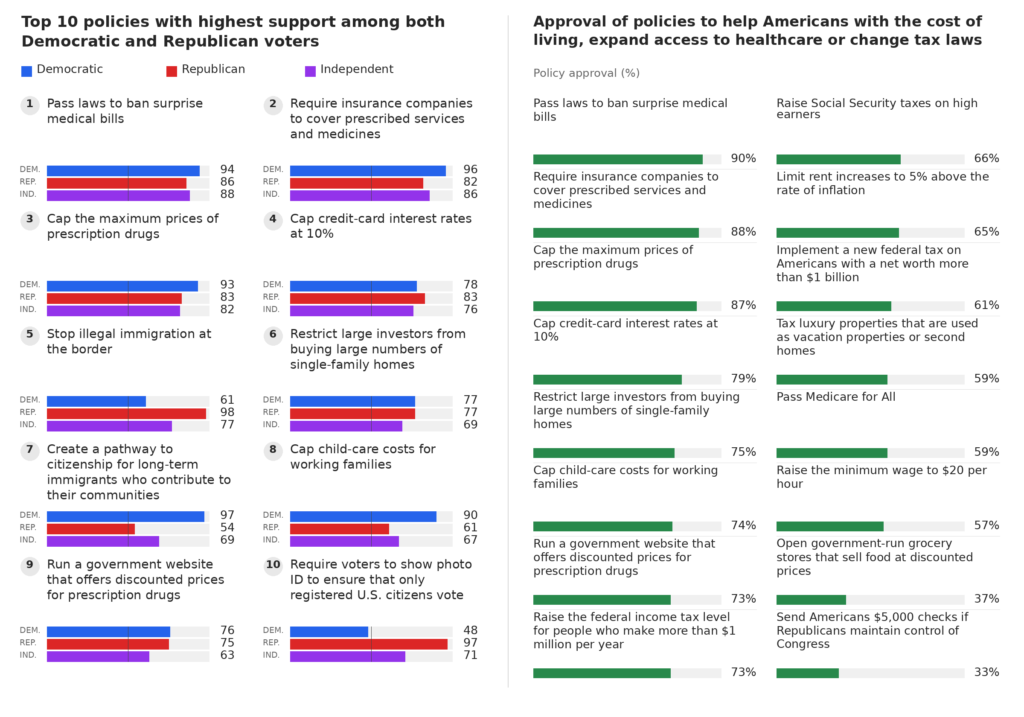
Those results suggest voters distinguish among forms of intervention rather than simply embracing anything that can be labeled populist.
The Pollsters Themselves Come From Opposite Political Camps
The Journal’s polling team also carries relevant political context.
Anzalone is a longtime Democratic pollster who served as chief pollster for Joe Biden’s 2020 presidential campaign and has worked for Democratic Party committees and candidates. Impact Research lists Anzalone’s political work.
Geller comes from the Republican side. His firm says he worked on all three of Trump’s presidential campaigns, either directly or through sanctioned pro-Trump super PACs, and has conducted work for major Republican campaign committees. National Research describes Geller’s campaign background.
The survey therefore was not produced exclusively by a polling operation aligned with either party. Its bipartisan polling team makes the cross-party findings more difficult to dismiss as the product of an obviously partisan survey shop.
Cross-Party Agreement Extends Beyond Economics
The same ideological mixing appeared on immigration and election policy.
Seventy-five percent supported creating a pathway to citizenship for immigrants who have lived in the United States for many years and contribute to their communities. At the same time, the Journal reported strong support for stopping illegal immigration at the border.
Seventy-two percent supported requiring voters to show photo identification to ensure that only registered U.S. citizens vote. The Journal reported that support included nearly half of Democrats, along with large majorities of Republicans and independents.
Those combinations do not fit neatly into conventional party platforms.
They may be evidence of populism. They may also show something simpler: voters can simultaneously favor enforcement and accommodation, markets and regulation, private enterprise and targeted government intervention depending on the particular problem.
The Journal survey offers strong evidence that affordability has weakened some traditional partisan boundaries. What it does not establish is that Americans have collectively adopted a coherent populist economic ideology.
The poll asked voters whether they wanted lower costs. It generally did not ask what they would sacrifice, pay in taxes, or give up in market access to obtain them. That distinction becomes important when popular proposals move from campaign slogans and survey questions into actual legislation.