

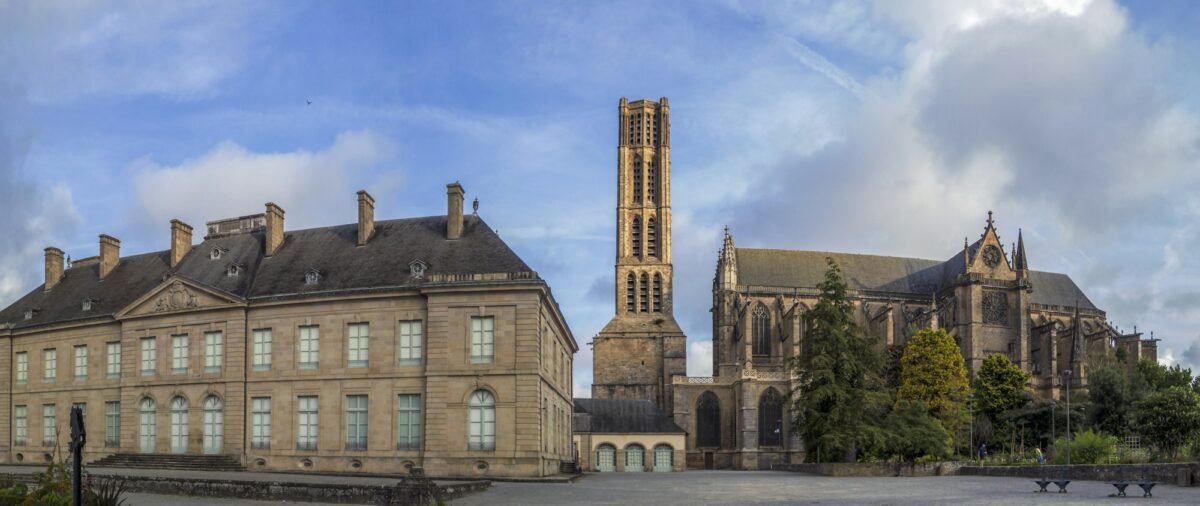
The Hôtel de Ville of Limoges survived two world wars. It could not survive the open borders of liberal globalism.
The burning of this 143-year-old landmark is the image the world will remember from France’s weekend of riots. But the building is not the real story. The real story is the fall of the French Republic itself: a state that no longer appears capable of defending its borders, preserving its institutions, or commanding the confidence of its own people.
A city hall the state could not protect
On Saturday, October 17, a march of about 5,000 people moved through Limoges. According to Mayor Guillaume Guérin, roughly 700 hooded, armed militants had infiltrated it, and by 3:30 p.m. the police holding them back had run out of ammunition. Rioters then stormed the Hôtel de Ville and threw firebombs inside. The roof caved in and the clock tower fell. The building was inaugurated on Bastille Day 1883 and has been a registered historic monument since 1975.
Haute-Vienne Prefect Maurice Barate called it a “catastrophe patrimoniale,” a heritage catastrophe, and denounced it as a deliberate act. Guérin, a center-right Les Républicains mayor, went further. Police, he said, lacked the means and fell back, in Limoges as in other cities. The state, he said, had failed. He is now asking the government for a Marshall plan to rebuild.
When the mayor of a quiet provincial city better known for porcelain than politics says the Republic could not protect its own town hall, the debate over whether France has a law-and-order crisis is over.
Limoges was the starkest scene, not the only one. Looting hit cities from Paris and Lyon to Marseille and Bordeaux.
| Measure | Figure | Source |
|---|---|---|
| Marchers nationwide, Oct. 17 | About 550,000 | French authorities |
| Arrests, as of Sunday evening | 2,397 | Interior Ministry |
| Police and gendarmes injured | 997 (7 critical) | Interior Ministry |
| Protesters killed | 1 | Interior Ministry |
| Businesses damaged or looted | About 3,000 | French officials |
On October 20, police arrested a man on France’s fiche S security watch list for ultra-left activity in connection with the Limoges fire. The national anti-terrorism prosecutor is monitoring the case, though it is not being treated as terrorism at this stage. Prime Minister Sébastien Lecornu said ultra-left groups organized the violence in several cities. He also rebuked Jean-Luc Mélenchon, who had blamed the police command for the chaos, saying no one can call for an end to violence while making excuses for those who commit it.
How a school protest became an uprising
Legacy media want the public to see legitimate protests over schools and the cost of living. That is how it started. In September, teachers walked out over a chronic shortage of staff and resources, and students blockaded their high schools. By the end of the month, the demonstrations had mutated into something far more violent and far more sinister. Crumbling schools supplied the spark. What followed was an organized uprising against the French state.
A growing number of analysts describe the forces behind it as a red-green alliance. The red is the revolutionary left, the militant Marxists. The green is radical environmentalism and political Islam. They disagree about the society they ultimately want, but they share a common enemy: France, capitalism, and Western civilization.
In this reading, the alliance runs on a division of labor. Professional far-left activists supply the organization, the ideology, and the strategy. Islamist movements supply the demographic energy and the grievances. Second- and third-generation migrants in France’s heavily Islamic suburbs supply many of the foot soldiers who carried the violence from the schools into the streets. And Palestinian flags keep appearing at demonstrations supposedly about French classrooms. Those flags reveal a movement that sees France as one front in a much larger global struggle.
The theory binding the coalition is third-worldism. Like Marxism, it reads inequality through systems of exploitation. But it moves the struggle from class to civilization: the enemy is no longer the bourgeoisie but the West itself. The Marxists want to destroy capitalism and replace the Fifth Republic with a radically transformed state. The Islamists want to destroy the Christian foundations of Europe. The radical greens want to dismantle the industrial order that made the modern West possible. Different ideologies, different end goals, the same immediate target.
The root cause: open borders
How did France get here? Decades of mass migration. France brought in millions of people from Islamic countries without assimilating them into a common French identity.
Globalism said assimilation was unnecessary. Worse, it called assimilation racist. All France needed, the argument went, was a managerial system in which everyone is formally equal under the law. Instead of a unified nation, that system produced parallel communities: physically inside France, but culturally, politically, and spiritually alienated from the French nation.
What France is living through now is the reckoning so many predicted for decades. Left unanswered, it points toward civil war.
A modern-day Nero
On Friday, October 16, with France already a month into unrest, Emmanuel and Brigitte Macron sat in the balcony at Paris La Défense Arena for the next-to-last show of Céline Dion’s Paris residency. The next day, Limoges burned. A modern-day Nero.
On Sunday evening, Macron addressed the nation. He blamed “seditious elements from far-left factions, joined by numerous delinquents” and promised that those who sought to bring down the Republic would be held accountable. He refused his interior minister’s resignation.
It was the voice of an exhausted government, one that increasingly appears incapable of defending the French people, enforcing the law, or even championing a distinct French identity.
A tsunami of nationalism
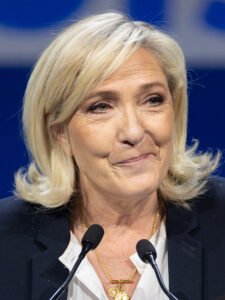

While France counts the damage, a tsunami of nationalism is sweeping the country, led by Marine Le Pen and the National Rally. Le Pen calls this a profound crisis of identity, a crisis of confidence, and a crisis of authority. On one side stand the forces of destruction: far-left extremists, Antifa militants, and the political leaders who legitimize their disorder. On the other stands a government that no longer seems able to stop them.
Le Pen was the clear favorite for the 2027 presidential election before a single window was smashed. An Elabe poll for BFMTV and La Tribune Dimanche, taken October 14 to 16, in the days just before Limoges burned, has her leading every first-round scenario with 31 to 33.5 percent. She wins every runoff tested: 69 percent against Mélenchon, 53.5 percent against center-left candidate Raphaël Glucksmann, and 52.5 percent against former Prime Minister Édouard Philippe. The first round is April 18, 2027, six months from now.
The public mood was visible before the riots, too. A September Ipsos bva-CESI barometer for La Tribune Dimanche found 64 percent agreeing that certain rights and benefits should be reserved for French citizens. Fifty-three percent said the National Rally could restore order, up from 42 percent. Fifty-six percent said the party is less extreme than it used to be, up from 50 percent in April 2017. And 48 percent said it is ready to govern.
Something deeper is happening. Economic insecurity is merging with demographic and cultural insecurity. Millions of French voters believe mass immigration, failed assimilation, collapsing national confidence, and decades of political capitulation have shattered the social contract. They work, they contribute, they obey the law, and they are the ones expected to pay for the destruction left behind by those who do not.
That is Le Pen’s opening: a coalition far larger than her traditional base. It reaches nationalist populists, conservatives, disillusioned centrists, apathetic voters, and working-class families who pay ever-higher taxes while their country comes apart. Mélenchon promises a multicultural “new France.” Le Pen promises borders, order, national preference, and cultural continuity. Voters who do not particularly like her are concluding that the alternative is far worse.
If the riots harden what the polls already show, April could bring a landslide, and a movement strong enough to crush this third-worldist revolt at the ballot box once and for all.
Civilizational populism
What is emerging in France has a name: civilizational populism. It rises when ordinary people stop seeing politics as a contest between the conventional left and right. Instead, they see a deeper conflict between the people who inherit and sustain a civilization and an increasingly isolated elite that appears hostile toward that inheritance.
The dividing lines become borders, sovereignty, religion, family, cultural memory, and national independence. Beneath them all sits one question: whether Europeans retain the right to decide what Europe will become.
That is why these riots may do more than destroy buildings. They may carry Marine Le Pen into the Élysée Palace and trigger a radical transformation of politics across the West. Once voters conclude that the political establishment is not merely failing to defend their civilization but is presiding over its dissolution, elections stop being debates over policy. They become referendums on survival.
At that moment, the question is no longer whether the populists are too radical. The question is whether anything short of radical change can save Europe at all.
Featured photo: Limoges, with the Cathedral of Saint-Étienne, by snap wander on Unsplash. Charts: Midpoint News.