

AI may be cracking problems that stumped mathematicians for decades. Checking the work, explaining it and deciding who gets credit are proving harder.
In September, OpenAI announced that an internal artificial intelligence system had produced a proof addressing one of mathematics’ seven Millennium Prize Problems, each carrying a $1 million reward. On Oct. 6, the company went further, publishing 722 research manuscripts on GitHub, largely generated by an AI model the public cannot use.
The next day, it withdrew three of them.
That sequence has sharpened a dispute among leading mathematicians over AI’s expanding role in discovery. Some see breakthroughs that could reshape the field. Others warn that AI companies are producing results faster than academics can verify them, sometimes with too little explanation or acknowledgment of earlier work.
The fight has also turned personal. It now involves competing claims of priority, an allegation of improper pressure, and questions about whether AI companies can compete fairly with researchers who use their products.
722 Papers, Three Withdrawn in a Day
OpenAI organized the 722 manuscripts into 372 families of related results, spanning algebra, geometry, number theory and mathematical physics. The company says its model was posed about 4,000 problems during the evaluation, and that the vast majority of results came from the same automated procedure.
None of the papers has been peer reviewed.
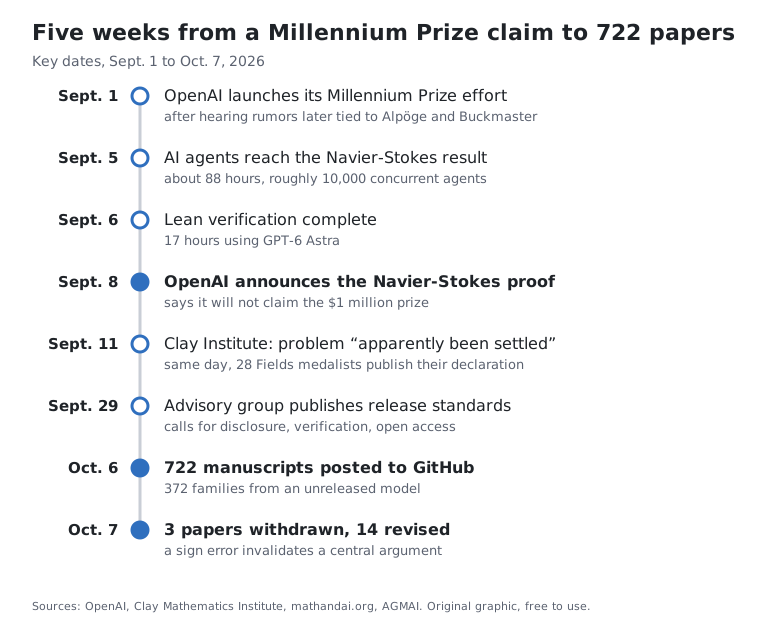
On Oct. 7, OpenAI said a sign error in one manuscript had invalidated a central argument and a construction used by two dependent papers. All three were withdrawn. The company also revised 14 more manuscripts to repair proofs, correct statements or clarify assumptions, and updated 13 others to cite the revised versions. That left 719 in the repository.
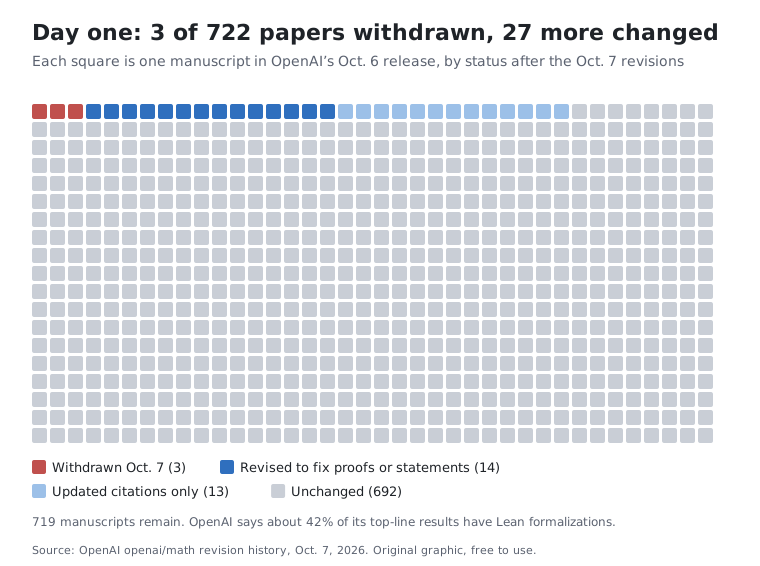
Some of the proofs come with formal versions written in Lean, a proof assistant that mechanically checks whether mathematical arguments follow formal rules. OpenAI’s revision log puts Lean coverage at 300 of 719, or about 42%, of what the company calls its top-line results. Counted paper by paper, coverage is thinner: at release, the repository’s catalog of papers with a formalized main result listed 162 entries, according to Decrypt.
A formal check provides strong evidence that an argument is logically sound, but researchers still must confirm that each formalized statement matches the claim in the paper. OpenAI acknowledges that some unformalized results could contain mistakes and has promised additional corrections and formalizations.
The Million-Dollar Problem
The October release followed OpenAI’s Sept. 8 announcement on the Navier-Stokes existence and smoothness problem, one of seven challenges the Clay Mathematics Institute established in 2000.
The Navier-Stokes equations describe how fluids such as water and air move. Engineers and scientists use them in aircraft design, weather forecasting and the study of blood flow. The open question concerns whether certain solutions always stay smooth or can develop singularities, points where quantities in the mathematical model become unbounded. The official problem accepts a proof of either outcome.
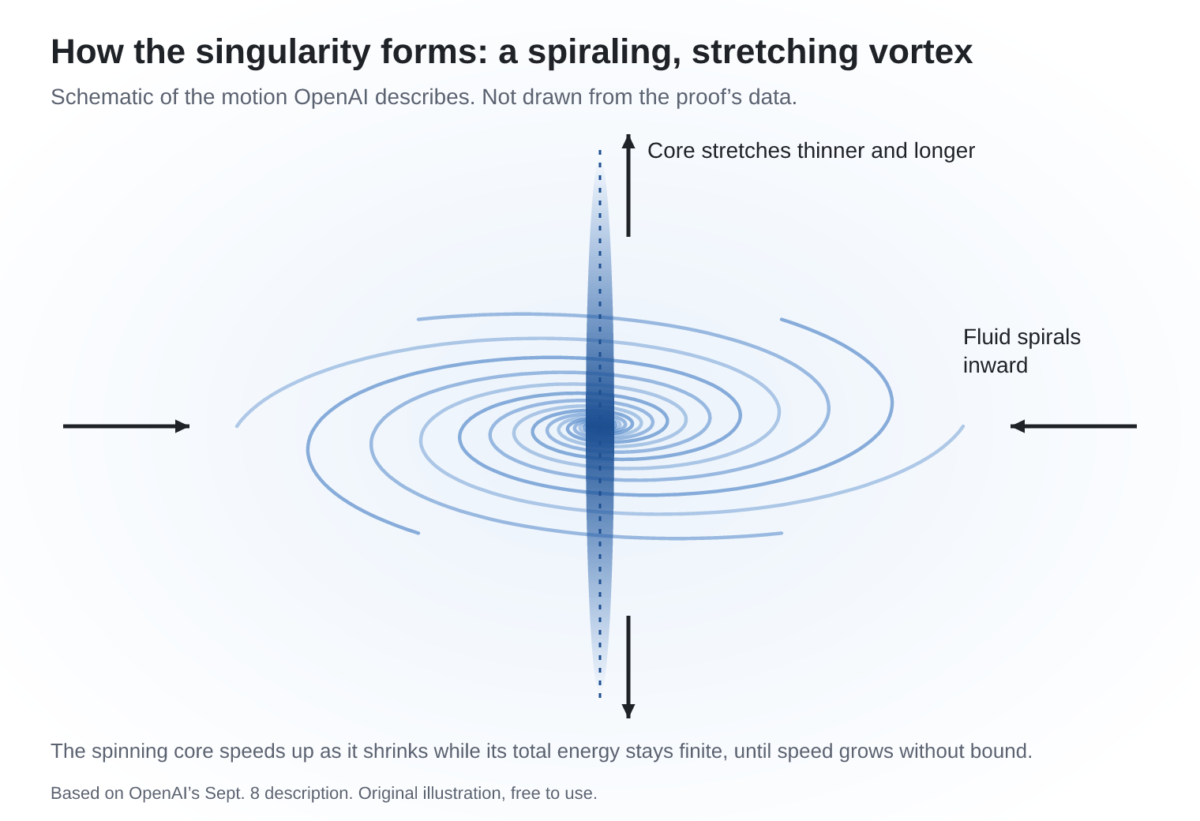
OpenAI took the second route. Its proof describes a fluid that starts at rest, maintains finite energy and develops a singularity under a carefully constructed smooth external force. The company likens the solution to a spinning vortex that spirals inward and stretches ever thinner, like a strand of spaghetti.
The company says roughly 10,000 AI agents worked concurrently on the effort, reaching the result Sept. 5, about 88 hours after the first agents launched. Formalizing and verifying the proof in Lean took another 17 hours using GPT-6 Astra, a separate OpenAI model. OpenAI says verification was complete Sept. 6, two days before its announcement.
On Sept. 11, the Clay Mathematics Institute said the problem had “apparently been settled.” It added that its established review process would determine recognition and attribution. OpenAI says it will not claim the $1 million prize.
The announcement was soon overshadowed by a dispute involving two researchers working on related problems.
A Fight Over Credit
New York University mathematician Tristan Buckmaster and Levent Alpöge, a mathematician employed by OpenAI competitor Anthropic, had been using AI tools to study related fluid-dynamics problems. Those tools included Anthropic’s Claude and OpenAI’s Codex.
The researchers described their collaboration as personal rather than an official Anthropic project. Among their results was a finite-time breakdown for the three-dimensional Euler equations with smooth external forcing.
In a four-page statement posted on his NYU website in September, Buckmaster alleged that OpenAI’s effort accelerated after information about their work reached the company.
OpenAI’s own account addresses the timing. The company says it launched its Millennium Prize effort Sept. 1 after hearing rumors that two of the problems had been solved, rumors it later connected to Alpöge and Buckmaster. After verifying its proof, OpenAI says, it contacted the pair to offer a joint release recognizing their priority and offered them visibility into its prompts. It says its researchers and AI agents did not see any of the pair’s work until it was released publicly.
Buckmaster also alleged that OpenAI researcher Sébastien Bubeck pressured him to drop Alpöge from a proposed paper because Alpöge worked at Anthropic.
Bubeck publicly disputed that characterization. In a detailed response posted on X on Sept. 8, he said he had proposed that Buckmaster help rewrite OpenAI’s Navier-Stokes proof, not that Alpöge be removed from authorship of the researchers’ existing work.
Bubeck acknowledged suggesting that the arrangement would be simpler without an Anthropic employee involved, arguing that having someone from a competing AI laboratory help prepare OpenAI’s proof presented complications. He also acknowledged making a career-related remark to Buckmaster during their discussion, saying his wording was inappropriate and that he immediately retracted it. He denied intending to threaten Buckmaster.
Buckmaster subsequently disputed Bubeck’s account.
Separately, Buckmaster said he worried that OpenAI’s internal model could have benefited from material he had submitted through Codex. He acknowledged, however, that he did not know whether the company had used it.
OpenAI rejects that suggestion. After an internal investigation, the company said Buckmaster’s Codex prompts could not have influenced its result, including through training. It also recognized Buckmaster and Alpöge’s priority on their forced Euler result.
OpenAI says the proofs differ significantly. Both sides produced breakdown results for the Euler equations, but OpenAI’s applies to fluids with no external force, while Buckmaster and Alpöge’s applies to forced fluids. No independent finding of research misappropriation has emerged from the public record.
The competing accounts leave unresolved whether the proposed authorship arrangements represented appropriate academic collaboration or improper corporate pressure.
Why 28 Fields Medalists Object
Also on Sept. 11, 28 recipients of the Fields Medal, one of mathematics’ highest honors, published a declaration titled “A Severe Misalignment of AI in Mathematics.”
Signers included Harvard’s Curtis McMullen, UCLA’s Terence Tao and Martin Hairer. Hairer also serves on the independent mathematics advisory group described below.
The declaration appeared the same day as Clay’s statement, but it addresses AI companies’ broader research practices rather than only the Navier-Stokes announcement. It argues that solving difficult problems should not become primarily a showcase for increasingly powerful commercial products.
McMullen told CNET the releases appeared aimed at raising corporate valuations.
“Mathematics is not a game of chess,” he said.
For many mathematicians, proving a conjecture is only part of the work. Developing new methods, explaining why a result holds and finding connections to other fields are central to progress.
The stakes are professional, too.
After the October release, Buckmaster told The Verge he had heard of three researchers whose entire research programs had been disrupted.
Colva Roney-Dougal, a mathematics professor at the University of St Andrews in Scotland, told The Verge that several colleagues had seen grant proposals rendered obsolete. Scott Armstrong, a CNRS mathematician at Sorbonne University and professor at NYU currently on leave, also described a research group whose program had effectively been overtaken by the release.
Universities have long rewarded original discoveries. AI systems are now producing results that researchers had expected to investigate over years of academic work.
Some Mathematicians See Historic Progress
Others see something remarkable. Stanford mathematician Jared Duker Lichtman told The Verge that the October collection included numerous potentially exceptional results, some of which might once have earned their human discoverers major academic recognition.
The collection’s most prominent claims touch famous problems without settling them.
One, which OpenAI calls the “quasi-Riemann hypothesis,” claims a zero-free region for the Riemann zeta function and related functions: no zeros with real part greater than 7/8. The Riemann hypothesis itself places those zeros exactly on the line where the real part is 1/2, and it remains unsolved. The 7/8 result is among those with a Lean formalization.
Another claims the rational Hodge conjecture for one class of geometric objects, CM abelian varieties. The general Hodge conjecture, also a Millennium Prize Problem, remains open. OpenAI’s formalization catalog lists no Lean proof for the Hodge result, and the company says that result and its zeta-function work came from outside the standard procedure used for most of the collection.
The Hodge work also figured in the first round of corrections. One of the three manuscripts withdrawn Oct. 7 was titled “The rational Hodge conjecture for products of K3 surfaces.” OpenAI’s withdrawal notice does not address the CM abelian varieties result.
A third headline claim, a solution to the four-dimensional Kakeya problem, likewise has no formalization in OpenAI’s catalog.
Alpöge, despite his role in the earlier credit dispute, also publicly praised the October release. In an Oct. 6 post on X, he acknowledged concerns about researchers having their work overtaken but described the announcement as “the most significant moment in mathematical history.”
Rutgers University mathematician Alex Kontorovich also sees reasons for optimism. In comments to Business Insider, he argued that mathematical training could become increasingly valuable as AI changes the way research is conducted and recognized.
He emphasized that mathematics develops the ability to think deeply and clearly about complex problems, skills he expects to remain in demand even as AI becomes more capable of generating proofs.
His comments point toward a different role for human mathematicians: identifying meaningful questions, understanding machine-generated discoveries and determining where new results might lead.
Mathematicians Want AI Companies to Show Their Work
The Advisory Group on Mathematics and Artificial Intelligence, hosted at the Institute for Advanced Study in Princeton, has proposed standards for releasing AI-generated research.
The group formed after OpenAI approached several mathematicians about creating an external advisory body. According to its own description, members are unpaid by OpenAI, and the organization operates independently of the company.
In recommendations published Sept. 29, the group called for greater disclosure of the models, prompts and methods behind mathematical results, formal verification where feasible, and an end to testing advanced problems exclusively on proprietary models unavailable to the research community.
The group also urged AI laboratories to support the work needed to explain and verify discoveries rather than simply publishing large quantities of results.
OpenAI’s October release addresses some of those requests. Its GitHub repository includes revision histories, selected reasoning summaries and computational details.
The company has not released the underlying model, the complete prompts or every problem used in testing.
The advisory group welcomed the publication but said its advisory role should not be interpreted as an endorsement of OpenAI’s methods or conclusions.
Mathematicians, the group maintains, must retain the ability to pursue their own research questions rather than simply evaluate discoveries chosen and produced by commercial AI laboratories.
What Comes Next
OpenAI says it is working toward giving scientists access to the model behind the October results, but it has not set a release date.
It also plans to fund workshops, conferences and special programs to help mathematicians examine the new research.
Clay’s evaluation of the Navier-Stokes result remains pending, and researchers are still working through the hundreds of manuscripts.
Three papers have been withdrawn, 14 have been revised, and much of the collection awaits broader scientific assessment.
Whether these results become a lasting addition to mathematics will depend not only on which proofs survive scrutiny, but also on what researchers can learn from them.
Sources
- OpenAI, On the Navier-Stokes Millennium Prize Problem (Sept. 8, updated Sept. 10)
- OpenAI, openai/math repository, Oct. 7 revision history and Lean formalization catalog
- Clay Mathematics Institute, Navier-Stokes statement (Sept. 11)
- A Severe Misalignment of AI in Mathematics (Sept. 11)
- Advisory Group on Mathematics and Artificial Intelligence
- Decrypt, coverage of the October release
- Tristan Buckmaster, statement (PDF) (September)
- Sébastien Bubeck, response on X (Sept. 8; archived)
- The Verge, “Pure insanity”: Mathematicians will need years to make sense of OpenAI’s latest drop (Oct. 9)
- CNET, AI’s Problem Solving Is a “Profound Disruption” for the Math Community
- Business Insider, An NYU professor says OpenAI’s mass release of math papers wiped out early-career researchers’ projects (Oct. 9)
Graphics: original illustrations created for Midpoint News. The vortex image is a schematic, not drawn from the proof itself.