
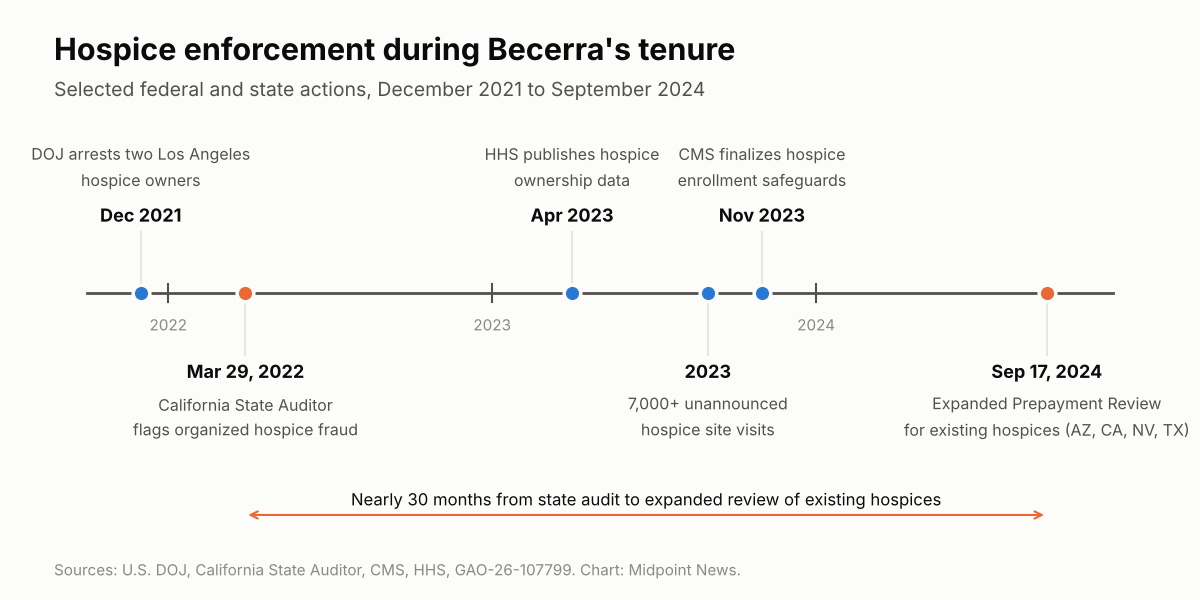
While Xavier Becerra ran the Department of Health and Human Services, sham hospices in Los Angeles kept billing Medicare for patients who were not terminally ill, or who never received care at all, and Medicare kept paying. California’s state auditor warned of organized hospice fraud in March 2022. Medicare did not begin expanded prepayment review of existing California hospices until September 2024, nearly 30 months later.
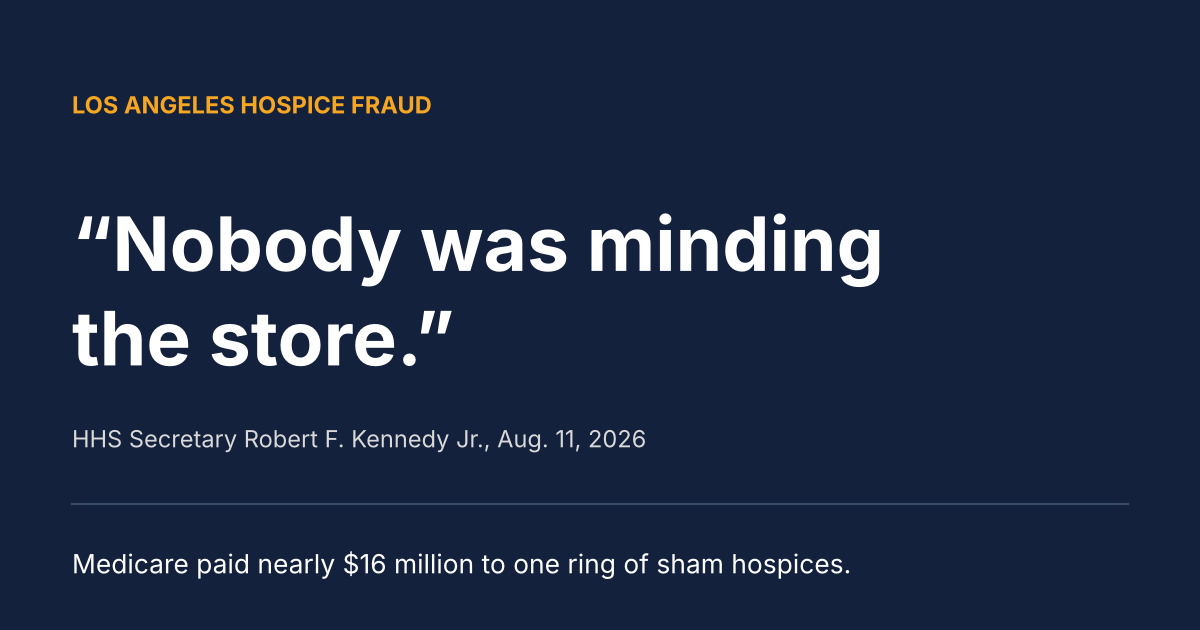
Now Becerra’s successor says he knows why. At an August 11 White House Task Force to Eliminate Fraud press conference in Los Angeles, posted by HUD and first reported by the California Globe, HHS Secretary Robert F. Kennedy Jr. said that when Becerra arrived, the department had 80 program-integrity employees overseeing $2.2 trillion in annual payments, and that Becerra “came in and transferred 76 of them out.” Fraud in Los Angeles, Kennedy said, was “all stolen because nobody was minding the store.” Of Becerra, he said: “He let the people steal the money.”
Becerra, the Democratic candidate for California governor in the November 3 election, had not issued a detailed response as of the Globe’s report, and we found no later public answer.
What the fraud cost taxpayers
- A Downey hospice and its co-conspirators billed Medicare about $28 million between 2011 and 2018, and Medicare paid more than $17 million.
- A ring of sham hospices organized by Petros Fichidzhyan collected nearly $16 million from Medicare. A court ordered him to pay $17,129,060 in restitution. The government seized $2,920,383 from associated bank accounts and obtained preliminary forfeiture orders for two homes.
- Sophia Shaklian’s bogus hospice and diagnostic-testing operation ran from March 2019 to August 2024, straight through Becerra’s tenure, and cost Medicare at least $14,103,043.
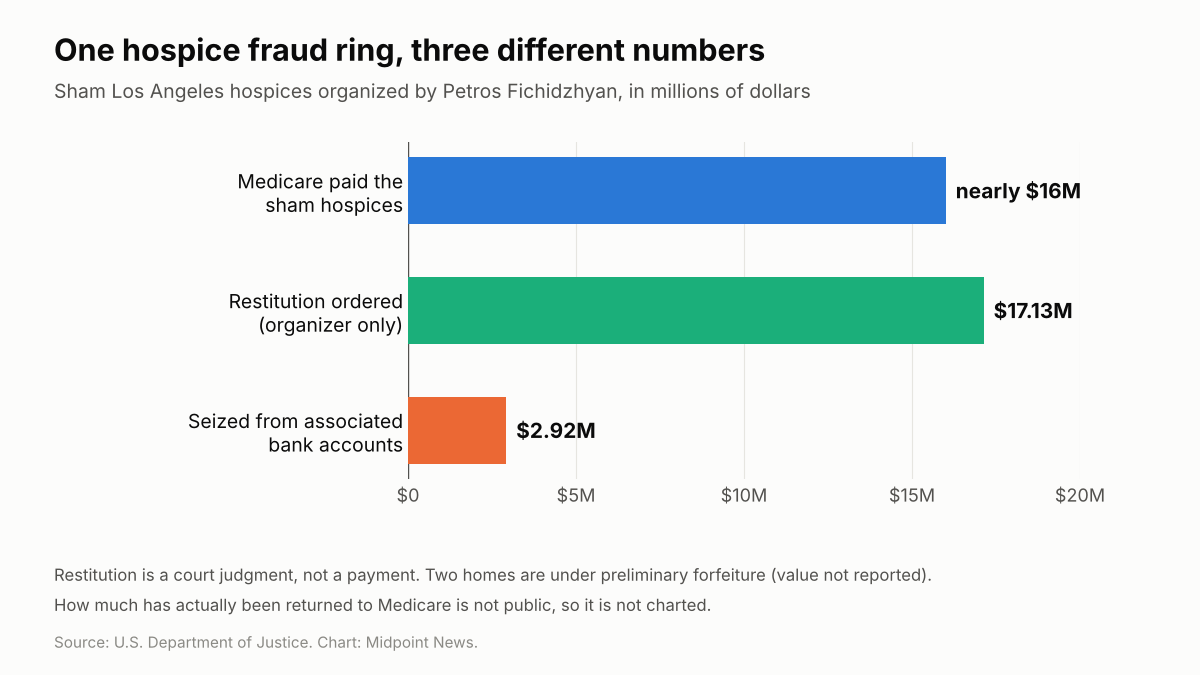
Restitution orders are court judgments, not repayments. How much of this money has actually come back to Medicare is not public.
The warnings, and the response
- December 2021: The Justice Department arrested two Los Angeles hospice owners.
- March 2022: Federal agents made arrests in a scheme that received more than $30 million from Medicare, and California’s state auditor reported organized hospice fraud in Los Angeles County.
- April 2023: HHS published hospice ownership data.
- 2023: CMS ran more than 7,000 unannounced hospice site visits, which the Government Accountability Office describes as covering every Medicare-enrolled hospice.
- November 2023: CMS placed hospices in its highest enrollment-screening category and extended ownership-change rules to them.
- September 17, 2024: Expanded prepayment review began for existing hospices in Arizona, California, Nevada, and Texas.
Federal agencies did act. The question is whether they acted fast enough. Over the same years, the number of providers whose Medicare payments were suspended in contractor fraud cases fell from 451 in fiscal 2022 to 303 in fiscal 2024. Kennedy says hospices that had “been busted before” were still being paid.
Kennedy also says Becerra “instituted a program called pay and chase,” paying claims that algorithms flagged as “almost certainly” fraudulent and trying to recover the money later. Medicare has been trying to get away from pay and chase since at least 2011. The question for Becerra is why it persisted on his watch while Los Angeles hospice fraud was flagged and growing.
What the records show so far
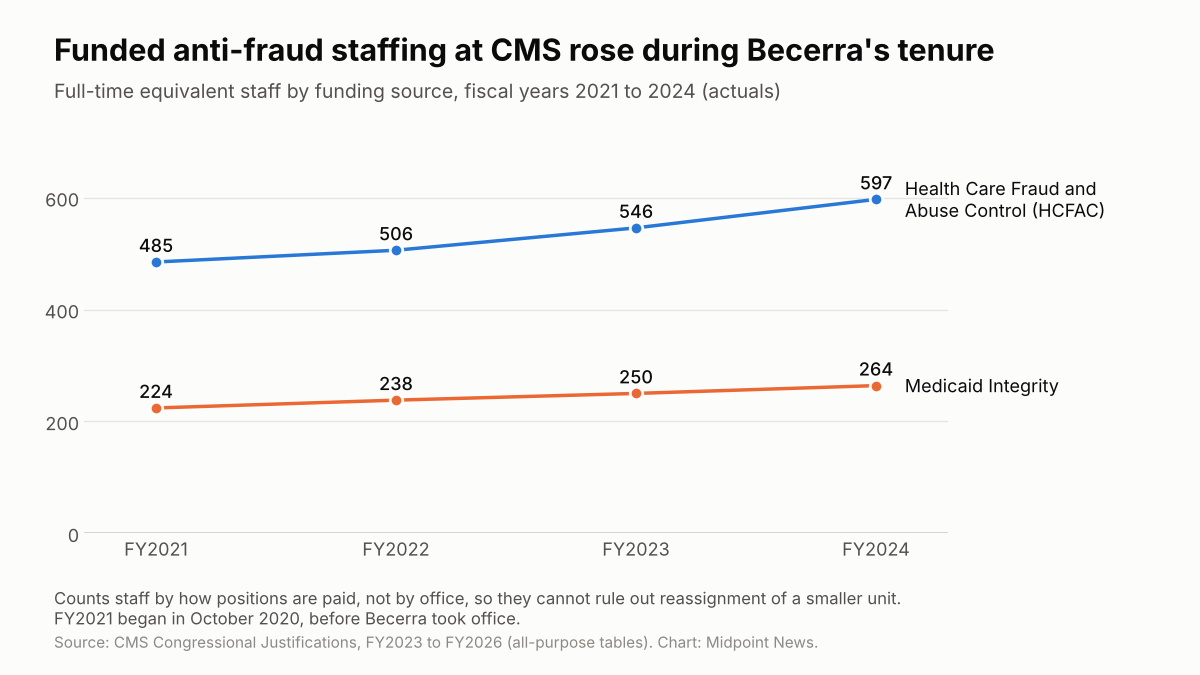
Kennedy did not name the office he was describing. He put the remaining staff at six rather than four, a small gap that could reflect attrition or a misstatement. CMS budget documents show staff funded by its main anti-fraud account rising from 485 to 597 between fiscal 2021 and 2024 (FY2023, FY2024, FY2025, and FY2026 justifications). Those totals count funding, not offices, so they do not settle whether a specific unit was emptied. Only HHS’s own records can.
What Becerra must answer
- Why did CMS wait until September 2024 to put existing California hospices under expanded prepayment review, and what protected taxpayers before then?
- Why did payment suspensions fall while fraud warnings mounted?
- How did previously caught operators keep billing?
- Did he approve moving program-integrity staff, and if so, why?
What HHS should release
The office Kennedy described, its dated staffing rosters, the transfer orders and who signed them, and any directive to pay flagged claims. If the records match Kennedy’s account, taxpayers deserve to see them before November 3.