
Gov. Gavin Newsom has signed a law requiring large companies to search their records and swear, under penalty of perjury, whether they or their predecessors profited from slavery. The mandate takes effect only after the Legislature appropriates funding.
Assembly Bill 2599, the Truth in Disclosure Act, was authored by Democratic Assemblymember Isaac Bryan and signed Sept. 30. It applies to businesses operating in California with more than $100 million in annual worldwide gross receipts that existed, or had a predecessor that existed, on or before Dec. 31, 1964.
Covered businesses must search their own records and those of related entities for evidence that they bought or sold enslaved people, used them as collateral, financed their purchase, or insured them or related transactions. Findings go to the state Civil Rights Department in a sworn affidavit. Covered businesses bidding on or renewing state contracts worth at least $100,000 must also certify, under penalty of perjury, that they have filed.
The department must build a searchable public database within one year after funding is appropriated. Alongside the affidavits, the database will publish estimates of the value or revenue gained from slavery-related business, including sales of enslaved people, insurance claims paid and goods produced by enslaved labor. Covered businesses operating in California as of Jan. 1, 2028, must file by Jan. 15, 2029, or Jan. 15 of the year after the platform is developed, whichever is later.
The total cost is unsettled. During Senate review in August, the Department of Finance opposed the bill over projected costs. It cited a Justice Department estimate of $130,000 in 2026-27 and $231,000 a year ongoing, California Black Media reported. Those figures predate amendments assigning administration to the Civil Rights Department and do not establish the final program’s total cost.
Supporters see the database as groundwork for broader reparations. Equal Justice Society board member and former Reparations Task Force member Donald Tamaki called the disclosures a first step toward carrying out the task force’s broader recommendations. The sponsoring Alliance for Reparations, Reconciliation and Truth says the database will help researchers, journalists and advocates trace corporate ties to slavery.
Some ties are already documented. Citing the state’s reparations report, CalMatters noted that two banks later acquired by JPMorgan Chase accepted about 13,000 enslaved people as loan collateral in Louisiana. When borrowers defaulted, the banks took ownership of about 1,200 of them. JPMorgan apologized in 2005.
Insurance industry groups opposed the bill, according to a June Senate Judiciary Committee analysis. The opponents included the American Council of Life Insurers and the American Property Casualty Insurance Association, and they argued the bill duplicated disclosures California already required. Under a 2000 law, the state surveyed 1,357 insurers. Its May 2002 report found that most had nothing to disclose, while a handful, including Aetna, AIG and New York Life, produced records. The new law lets insurers include documentation submitted under that earlier requirement.
The law requires disclosure, not compensation. Bryan told CalMatters that once the records are public, it will be “up to us to decide what that means.”
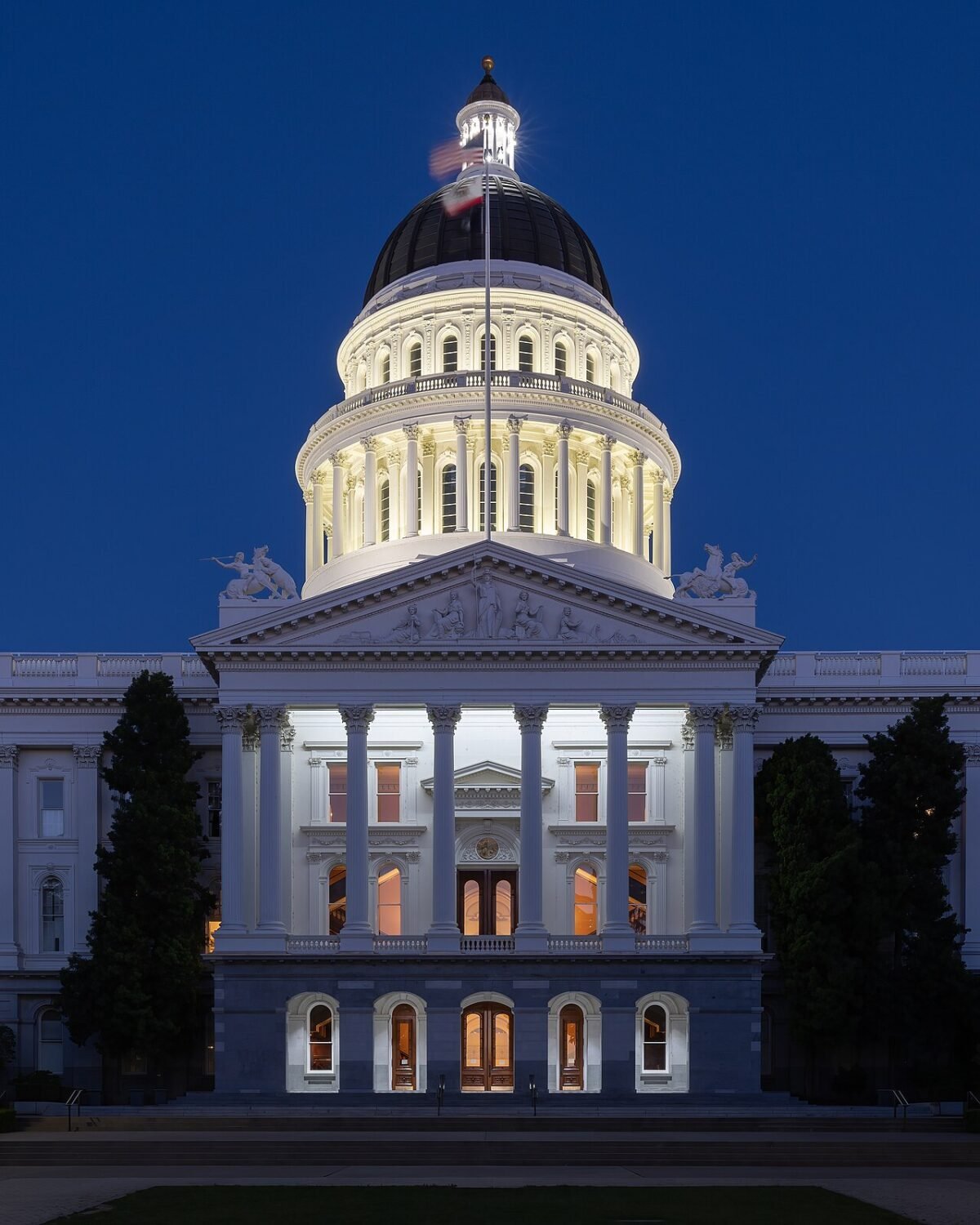
Featured photo: The California State Capitol in Sacramento during blue hour, April 8, 2022. Photo by Frank Schulenburg via Wikimedia Commons, licensed under CC BY-SA 4.0.
