
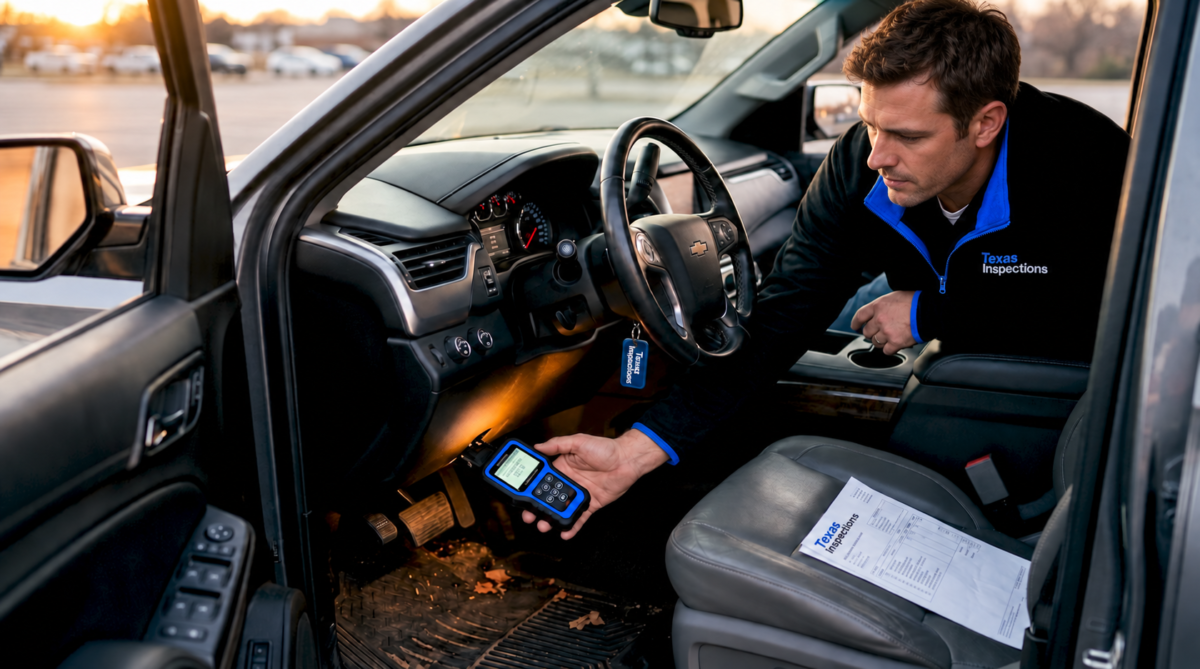
Bexar County motorists will face a new requirement beginning Nov. 1, when annual vehicle emissions inspections become mandatory for most gasoline-powered cars and light trucks before registration can be renewed.
The approaching deadline has prompted warnings about long lines, too few inspection stations and potentially expensive repairs for motorists whose vehicles fail. Those concerns are legitimate, but some of the most alarming projections circulating locally rely on assumptions that deserve additional context.
The emissions program is also not simply a new San Antonio or Bexar County policy. It stems from the federal Clean Air Act after the San Antonio area failed to meet the Environmental Protection Agency’s 2015 ozone standard. Texas subsequently added Bexar County to its federally enforceable vehicle inspection and maintenance program, and EPA approved the revised state plan in April 2025. EPA
Bexar County is currently classified as a “serious” nonattainment area under the 2015 ozone standard, with a federal attainment deadline of Sept. 24, 2027. TCEQ
Fewer than 2 million vehicles are actually subject to testing
MySA reported that just under 310 Bexar County locations were certified to perform emissions inspections as of early October and raised the prospect of approximately 160,000 inspections a month by dividing nearly 2 million registered vehicles across the year. MySA
But total vehicle registrations are not the same as the number of vehicles subject to emissions testing.
TCEQ’s rulemaking projected approximately 264,223 Bexar County inspections during the first two months of the program, or about 132,000 per month if evenly distributed. The agency projected an annualized first-year inspection volume of approximately 1.585 million vehicles, increasing in later years as the county’s vehicle population grows. TCEQ rulemaking
The difference is significant because several categories of vehicles are excluded.
The Bexar County program generally applies to gasoline-powered vehicles that are between two and 24 model years old. Electric vehicles, diesel-powered vehicles, motorcycles and mopeds are exempt from the emissions inspection requirement. Newer vehicles also receive an initial exemption. TCEQ inspection overview
That does not eliminate the possibility of bottlenecks. Even 130,000 inspections a month represents substantial demand, and the number of certified locations does not reveal how many trained inspectors are actually working at each station or how many hours those businesses will devote to emissions testing.
Inspection-industry warnings come with a business interest
One of the most prominent warnings in the MySA report came from Charissa Barnes, CEO of Texas Tag & Title and Official Inspection Station, who predicted the county could have between 350 and 400 certified locations by Nov. 1 but warned motorists could still encounter significant delays.
Barnes has substantial experience with the inspection system, but she is also not a financially disinterested observer.
During TCEQ’s rulemaking process, Barnes identified herself as the CEO of Official Inspection Station, which operates inspection locations in Bexar County, and participated directly in discussions over the design and economics of the new program. Official Inspection Station and other industry participants argued that the initially proposed $11.50 inspection fee was too low and warned that inadequate compensation could discourage businesses from offering the service. TCEQ hearing record
TCEQ ultimately increased the maximum inspection fee to $18.50.
The industry’s economic concern was not without supporting evidence. A TCEQ-commissioned analysis found that, at an $18.50 inspection price, a low-volume inspection station performing about 73 inspections per month could lose approximately $561 per month after modeled costs. A medium-volume operation performing about 159 inspections per month was projected to make only about $153. The analysis estimated a station handling the full modeled cost structure would need roughly 141 inspections a month to break even. TCEQ fee analysis
That provides a potential explanation for why some businesses may obtain certification yet devote limited personnel or operating hours to inspections.
A failed test could cost considerably more than the inspection
Bexar County motorists subject to the program will pay up to $18.50 to the inspection station, plus a $2.50 state administrative fee associated with registration. TCEQ program highlights
That is separate from the $7.50 “inspection program replacement fee” Texas began charging most noncommercial vehicle owners after the Legislature eliminated the state’s annual safety-inspection requirement beginning Jan. 1, 2025. Texas DPS
The larger financial exposure comes when a vehicle fails.
For most modern vehicles, inspectors will use the vehicle’s onboard diagnostic system. An emissions-related malfunction indicator light or qualifying diagnostic trouble code can result in failure. DPS identifies potential problems including defective catalytic converters, faulty gas caps, fuel-metering problems, ignition issues and other emissions-control system defects. Some repairs can be relatively inexpensive, while certain problems can cost hundreds or thousands of dollars. Texas DPS emissions FAQ
Barnes told MySA that more than 20% of vehicles in experimental inspection runs conducted by her businesses failed, with catalytic converter problems among the most common issues. MySA
That figure should not be treated as a forecast of the countywide failure rate. MySA did not report the number of vehicles in Barnes’ test sample, how they were selected or whether they were representative of Bexar County’s vehicle fleet.
Motorists who fail and have the vehicle repaired can receive a free retest within 15 days if they return to the original inspection station. Texas also provides limited low-income time extensions, low-mileage waivers and individual-vehicle waivers under specified circumstances. An individual vehicle waiver generally requires at least $600 in qualifying emissions-related repairs before the vehicle can be considered. Texas DPS Bexar County FAQ
Those exemptions reduce the burden for some motorists, but they do not amount to a broad taxpayer-funded repair program. TCEQ’s previous Low Income Vehicle Repair Assistance, Retrofit, and Accelerated Vehicle Retirement Program has not been funded statewide since 2017. TCEQ adoption package
Why Bexar County is being required to test vehicles
Ground-level ozone is not emitted directly from a vehicle’s tailpipe. It forms when nitrogen oxides and volatile organic compounds react in sunlight. Vehicle exhaust is one source of those precursor pollutants, along with industrial facilities, power generation, construction equipment and other mobile and stationary sources.
EPA maintains that reducing vehicle emissions is therefore one component of bringing the San Antonio area into compliance with federal ozone standards. EPA
But the state’s technical modeling should not be interpreted as proof that the inspection program by itself will dramatically reduce San Antonio’s measured ozone levels.
In its federal submission, Texas modeled the Bexar County inspection program at approximately 15.01 tons per day of nitrogen oxides and 8.85 tons per day of volatile organic compounds under the proposed program. EPA’s required benchmark inspection program modeled 15.16 tons of nitrogen oxides and 9.41 tons of volatile organic compounds. The comparison was intended to demonstrate that Texas’ chosen program would perform at least as well as the federal benchmark. Federal Register notice
Those figures compare two inspection-program scenarios. They are not a simple measurement of pollution “with inspections” versus “without inspections,” so subtracting the numbers would not show how much pollution the new Bexar County mandate will eliminate.
The real-world effect of the program on San Antonio ozone concentrations will become clearer only after inspections begin and additional air-quality data are available.
Texas also argues some San Antonio ozone comes from outside the United States
There is another complication largely absent from the local debate.
Texas has argued for years that pollution transported into the state from Mexico and other sources outside the United States contributes to ozone readings in Bexar County.
TCEQ submitted a new Clean Air Act Section 179B demonstration to EPA in July 2026 contending that Bexar County and several other Texas nonattainment areas would meet federal ozone standards “but for” emissions originating outside the United States. TCEQ international transport analysis
That argument is disputed.
EPA rejected an earlier Bexar County international-transport demonstration, concluding that Texas had not adequately established the necessary connection between emissions originating in Mexico and the specific ozone exceedances recorded in Bexar County. EPA also cited evidence of contributions from emissions generated within Texas. EPA decision
TCEQ’s new 2026 submission gives the state another opportunity to make that case, but it does not suspend the existing emissions-inspection requirement.
The capacity problem is partly the result of two separate policies colliding
There is also an important distinction between the reason Bexar County must conduct emissions testing and the reason the inspection industry had to rebuild capacity before Nov. 1.
The emissions mandate stems from federal ozone requirements and Texas’ EPA-approved implementation plan.
Separately, the Texas Legislature passed House Bill 3297 in 2023, eliminating most annual noncommercial vehicle safety inspections beginning Jan. 1, 2025. That change sharply reduced demand for traditional inspection stations approximately 22 months before Bexar County’s emissions-testing requirement was scheduled to begin. Texas DPS
Some businesses left the inspection market or redirected employees elsewhere. Now the state and inspection industry are attempting to rebuild capacity for a narrower but still substantial emissions-testing market.
That makes warnings about lines and staffing shortages plausible, although estimates based on every registered vehicle needing an annual emissions test exaggerate the likely workload.
The central questions are therefore separate.
Under current federal and state law, Bexar County is required to implement the emissions program beginning Nov. 1. Whether the county has enough stations and certified inspectors to handle the initial volume without significant delays is less certain.
And while reducing malfunctioning vehicles should reduce some ozone-forming emissions, the magnitude of the program’s effect on San Antonio’s overall air quality, compared with the financial and logistical burden placed on motorists, remains something that should be measured against actual results rather than assumed in advance.