

Voting advocates say Cornerstone Church’s political activity makes it an inappropriate voting location, but Texas law permits churches as polling sites, Bexar County voters can use countywide vote centers, and the proposed replacement is also privately owned.
SAN ANTONIO — Bexar County’s decision to use Cornerstone Church as an early-voting location in the November general election has prompted objections from voting-rights advocates who argue that the prominent North Side megachurch’s history of conservative political advocacy makes it an unsuitable place to cast ballots.
The dispute raises a legitimate question about how Bexar County selects polling locations and whether officials should consider a facility’s political identity. Several facts, however, complicate the argument that Cornerstone is inherently disqualified or that voters are being required to enter a politically conservative church to participate in the election.
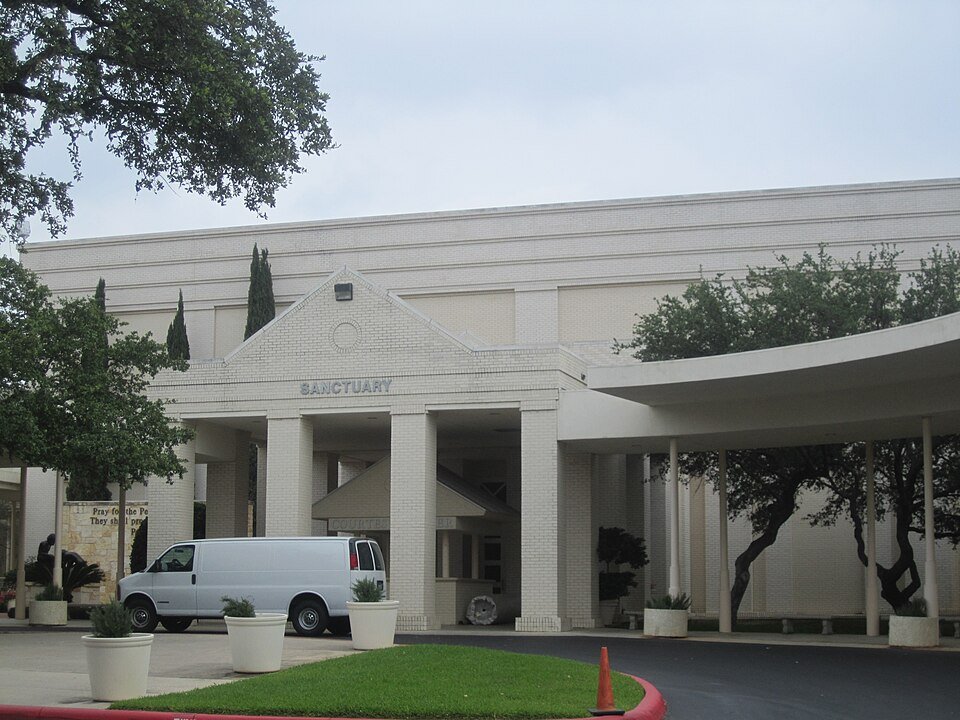
Cornerstone Church sanctuary in San Antonio. Photo by Billy Hathorn via Wikimedia Commons, licensed under CC BY-SA 3.0.

Most significantly, Bexar County participates in Texas’ countywide polling-place program. Under that system, voters are not limited on Election Day to a single assigned precinct polling location and may use an approved countywide vote center. During early voting, voters likewise have multiple county locations available.
Cornerstone is also not the only religious facility used for voting. Bexar County’s official voting-location lists include churches alongside libraries, community centers and government facilities.
Critics cite Cornerstone’s political profile
Valerie Reiffert, executive director of voter-mobilization organization Radical Registrars, and Kathleen Vale, both members of Bexar County’s Elections and Voter Engagement Advisory Committee, have urged officials to remove Cornerstone from the list.
Their central argument is that a polling location should appear politically neutral and welcoming to voters regardless of religion or political affiliation. They point to Cornerstone’s long history of conservative political engagement and the public positions of pastors John and Matt Hagee.
That political identity is well documented. John Hagee Ministries promoted a “Vote the Bible” message immediately before the 2024 presidential election, urging Christians to vote according to biblical values.
Cornerstone also hosted the ReAwaken America Tour in 2021, an event featuring former Trump national security adviser Michael Flynn, Roger Stone and Mike Lindell. Texas Public Radio reported that Matt Hagee later apologized for allowing the event, said organizers had not been properly vetted and stated that the church did not endorse the group’s views.
Those facts establish that Cornerstone has a significant conservative political profile. They do not, by themselves, establish that using the building as a polling site violates Texas election law.
Texas law expressly allows churches as polling locations
Texas law instructs election officials to use a public building when doing so is practicable. But if a suitable public building is unavailable, election officials may use another building. Texas Secretary of State guidance specifically identifies churches, clubhouses, private community centers and grocery stores as examples of private buildings that may serve as polling places.
The Election Code does not establish an ideological-neutrality test that automatically excludes a church because its leaders have spoken about politics. Instead, Texas regulates political activity occurring in and around the polling place during voting. State guidance explains the restrictions on electioneering within the legally protected area surrounding a polling-place entrance.
That distinction matters. Cornerstone’s sermons, political history or voter-engagement campaigns can be relevant to whether county officials consider the facility an appropriate choice, but those activities do not by themselves demonstrate unlawful electioneering at the polling place.

Election image by Element5 Digital via Unsplash.
The opposition also has political and advocacy context
The debate is not simply between a politically active church and politically neutral observers.
Reiffert leads Radical Registrars, which describes itself as a nonpartisan 501(c)(3) voter-registration organization. The group says it grew out of racial-justice protests in 2020 and focuses much of its work on young, Black, Indigenous, other minority and LGBTQ+ voters.
Vale has an additional political affiliation relevant to the debate. The Bexar County Democratic Party’s organizational roster lists Kathleen Vale as an appointed precinct coordinator for Precinct 2144.
At the same time, both women hold appointments to the county’s Elections and Voter Engagement Advisory Committee. The county says the committee serves as a liaison between residents and Commissioners Court and makes recommendations concerning election policy, civic engagement and voter participation. Their concerns therefore come from people who are both advocates and members of a county-created elections advisory body.
Commissioner Moody’s role
Precinct 3 Commissioner Grant Moody has been identified by critics as a defender of keeping Cornerstone on the approved list. Moody’s political orientation is not ambiguous: his official county biography describes his approach as “conservative, commonsense leadership” and notes that he founded the San Antonio Liberty Leadership Council, a conservative organization for young professionals.
That political background is relevant in the same way Cornerstone’s and the objecting advocates’ affiliations are relevant. It does not, by itself, resolve whether the county followed an appropriate process in selecting the location.
Proposed replacement is also privately owned
Reiffert and Vale have suggested replacing Cornerstone with the nearby Alzafar Shrine Temple.
That may be a viable alternative location, but describing Alzafar as a public facility can create a misleading impression about its legal status. Federal tax records compiled by ProPublica identify Alzafar Shriners as a private tax-exempt fraternal organization. It is not a government-owned public building.
Alzafar could still legally serve as a polling location. The distinction is that replacing Cornerstone with Alzafar would amount to choosing one private facility over another, not replacing a private church with a publicly owned government facility.
Transparency may be the stronger issue
A separate question concerns how Bexar County chooses vote centers. Texas Secretary of State guidance says counties using countywide vote centers must adopt a methodology for selecting locations. Suggested considerations include population, public transportation, availability of suitable buildings and compliance with the Voting Rights Act.
Whether Bexar County adequately documented and applied that methodology in selecting Cornerstone is therefore a legitimate administrative question separate from whether a church is legally eligible to host voting.
The Cornerstone controversy ultimately turns less on a clear statutory prohibition than on a disagreement over administrative judgment and perceived neutrality. Cornerstone unquestionably has a prominent conservative political identity, giving critics a factual basis for questioning the selection. But Texas law allows churches and other private buildings to serve as polling places, Bexar County uses multiple voting locations, and the alternative proposed by critics is itself a private organization.
The unresolved policy question is whether Bexar County should make perceived ideological neutrality an explicit part of its location-selection process even though state election law does not expressly impose such a test.