
San Antonio’s mayor and 10 City Council members received another salary increase on Oct. 1, the latest consequence of voter-approved charter changes that transformed the positions from minimally paid public service to full-time salaried offices.
Mayor Gina Ortiz Jones now earns $100,600 annually, up from $96,600, while council members earn $80,500, up from $77,000. The increases of approximately 4% and 4.5%, respectively, exceed the 3% raise provided for civilian employees under the city’s fiscal 2027 budget. Unlike an individually approved pay raise, the elected officials’ adjustments follow a formula adopted by voters in 2024.
From modest stipends to six-figure compensation
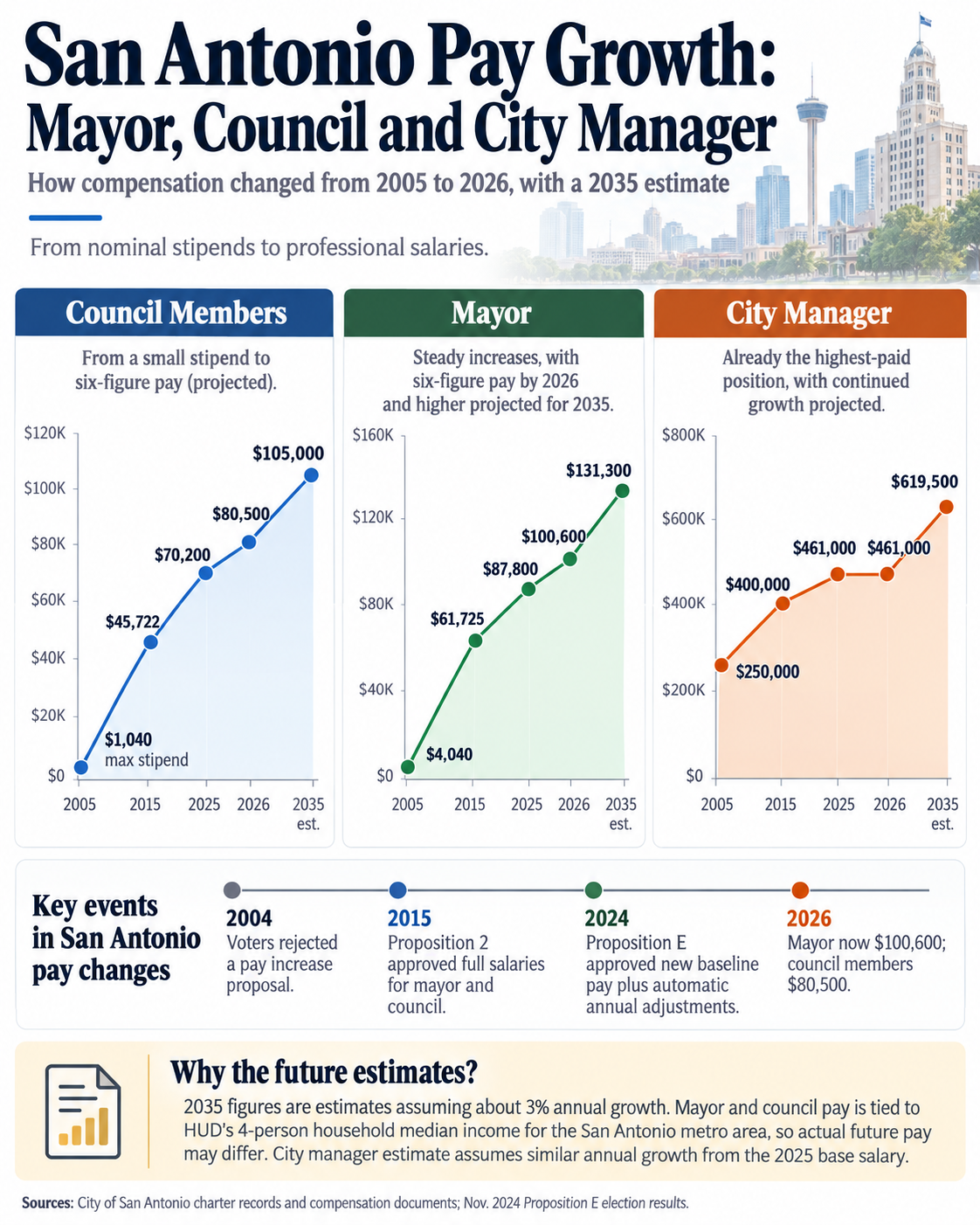
In 2005, council members could receive no more than $1,040 annually under a $20-per-meeting stipend. The mayor could receive up to $4,040. A proposal to replace those stipends with salaries was rejected by voters in 2004.
The turning point came in 2015, when voters approved Proposition 2, establishing $45,722 salaries for council members and $61,725 for the mayor. Supporters argued that compensation would make public office more accessible to residents who could not afford to serve while working another job. Critics questioned whether taxpayers should convert elected service into salaried employment.
In 2024, voters approved another major change, Proposition E, establishing baseline salaries of $70,200 for council members and $87,800 for the mayor. It also tied subsequent pay adjustments to the U.S. Department of Housing and Urban Development’s annual four-person household median-income figure for the San Antonio-New Braunfels area. Council members receive 80% of the benchmark; the mayor receives 100%.
That automatic formula means pay can adjust without a separate public vote each year. In October 2026, it put the mayor’s salary into six figures.
Twenty years of pay changes
In nominal dollars, council compensation has grown from a maximum $1,040 stipend in 2005 to $80,500 today. The mayor’s compensation has risen from $4,040 to $100,600. Those are striking increases, although they are not directly comparable to ordinary wage growth: voters changed the nature of the positions from modestly compensated service to jobs intended to support full-time officeholders.
Even measured from the more meaningful 2015 salaried baseline, compensation has risen approximately 76% for council members and 63% for the mayor. The accompanying salary graphic also compares the city manager’s pay, a separate appointed position whose compensation is established by contract rather than the HUD formula. Sheryl Sculley’s initial November 2005 contract set her base salary at $250,000; her 2015 base pay reached $400,000. Erik Walsh’s base salary increased to $461,000 effective in 2025.
What did voters understand?
Official results show that Proposition E passed in November 2024 by 266,808 votes to 149,921, or 64.02% of those voting on the measure. More than 73,000 voters left that ballot question unanswered.
But a University of Texas at San Antonio voter research project raised a significant question about how the measure was presented. When researchers described it directly as increasing the mayor’s and council members’ baseline salaries, support was substantially lower than when respondents saw the ballot’s actual language. The ballot described the amendment as setting and limiting compensation at particular amounts and authorizing subsequent adjustments.
UTSA’s findings suggest wording may have influenced support, but they do not prove any individual voter was misled. Likewise, although researchers identified age and other differences in reported election participation, turnout data cannot establish which demographic groups voted for or against this specific proposition. Individual ballots are secret.
Two routes to the ballot, two different hurdles
City Council initiated the 2024 charter question after work by a mayor-appointed charter review commission. State law permits a home-rule city’s governing body to submit charter amendments to voters on its own motion, through the city’s established legislative process.
Ordinary residents may also petition for a charter amendment, but must first gather valid signatures from at least 5% of qualified voters or 20,000 voters, whichever is smaller. In San Antonio, that means 20,000 signatures, subject to validation and timing requirements.
Citizen-initiated ordinances and referendums challenging eligible city ordinances face a different, often larger signature requirement under the charter, generally tied to 10% of qualified electors at the preceding regular municipal election. Some subjects are excluded, and referendum deadlines can be short. The precise signature threshold must be confirmed with election officials for a particular petition.
These are not identical legal procedures. Yet their practical difference is substantial: council members can decide to send charter questions to the ballot by a council vote, while residents seeking the same result through a petition must organize, collect and validate thousands of signatures before the proposal reaches voters.
Pay increases amid broader budget pressures
The fiscal 2027 budget totals approximately $4.4 billion, and elected-official salaries are a tiny share of overall city spending. The annual adjustments are not a significant driver of San Antonio’s budget challenges. Still, the compensation system invites a public-accountability question: when city employees receive smaller raises and government weighs taxes and service costs, should elected officials’ annual salary changes be automatic?
The increases were not newly voted on by Mayor Jones or the current council. Instead, they reflect decisions made through a series of charter elections in 2004, 2015 and 2024. Those votes changed not only how much elected officials receive, but who decides when their pay changes.
Sources and methodology
Sources include the city’s 2024 charter election canvass, Bexar County election results, 2015 city charter-review material, the 2005 city manager agreement, UTSA voting research and city compensation records. The 2035 figures shown in the accompanying graphic are illustrative estimates, not adopted salary schedules, and assume approximately 3% annual growth. The mayor/council projections are not guaranteed because HUD figures can change. The city manager projection is not a contractual commitment.
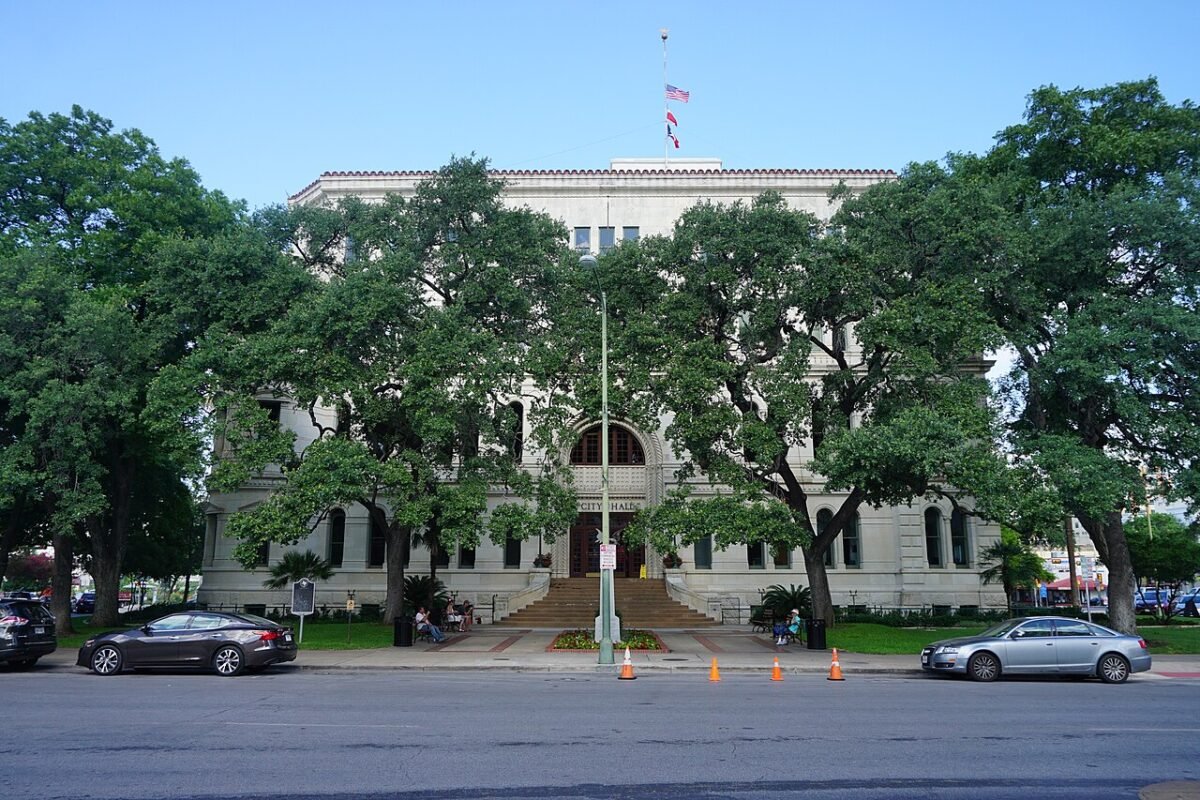
Featured image: San Antonio City Hall, photographed by Michael Barera. Wikimedia Commons, licensed under CC BY-SA 4.0.