
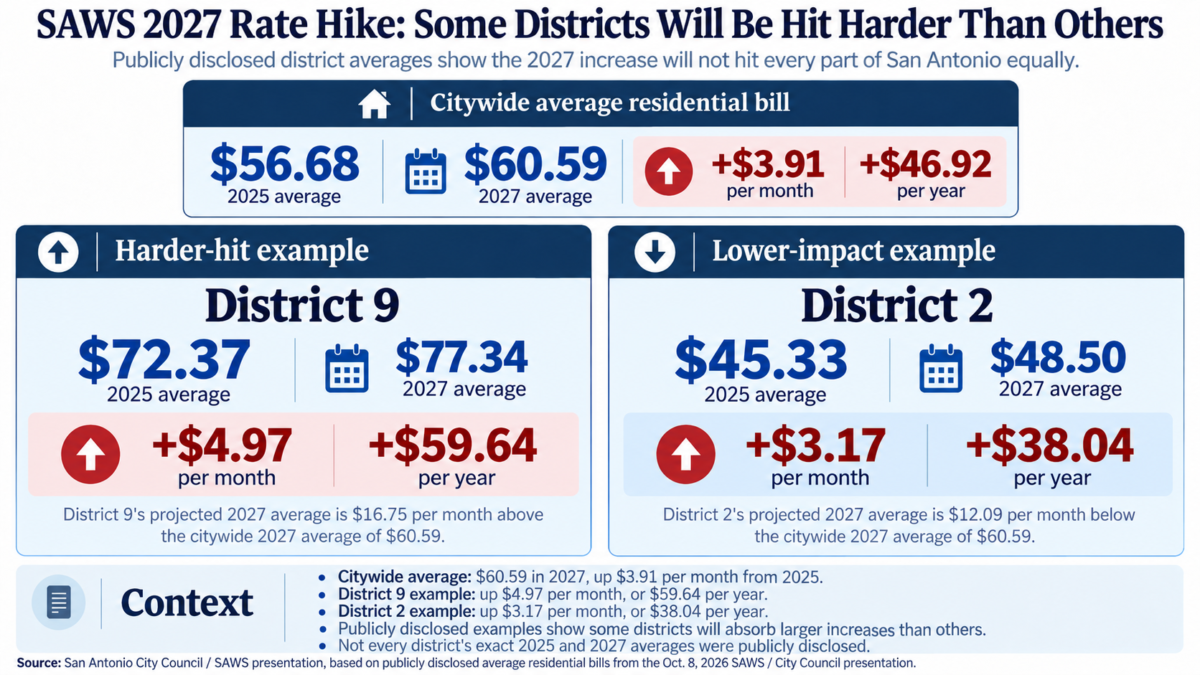
San Antonio residents will pay higher water and sewer rates beginning in January 2027, but the widely reported average increase of $3.91 per month does not describe what every household will pay.
SAN ANTONIO — The City Council voted 8-3 Thursday to approve a four-year rate plan for the San Antonio Water System (SAWS). Councilmembers Jalen McKee-Rodriguez, Misty Spears and Marc Whyte voted against the measure.
Residential rates are scheduled to rise 6.9% in 2027 and 6.5% in 2028, followed by increases within approved ranges in 2029 and 2030. By 2030, the combined impact could reach 29.1%, depending on the increases adopted in the final two years.
SAWS projects that its illustrative monthly residential water-and-sewer bill will climb from about $56.68 to $60.59 in 2027, potentially reaching $73.19 by 2030. But those figures warrant closer examination, especially for single-family homes with irrigated lawns or larger households.
What SAWS means by an “average” bill
The utility’s illustration assumes 6,275 gallons of monthly water consumption and 5,052 gallons of wastewater. Its earlier published material explicitly described that water-and-sewer comparison as excluding fees. Separately assessed charges, including stormwater and other pass-through fees, can make the amount appearing on a customer’s statement higher.
In a presentation to City Council, SAWS said nearly 70% of residential customers used less than 6,275 gallons in 2025. Council discussions also identified roughly 4,500 gallons as median residential consumption.
That means the arithmetic average is higher than the usage of most residential customers. A different distortion occurs when that benchmark is used to describe what homeowners with substantial outdoor irrigation or larger indoor water needs might pay: their actual bills can be well above the illustrative average.
SAWS’s own district-level analysis helps illustrate the variation. Using 2025 consumption patterns and the proposed 2027 rates, it reported average bills ranging from $48.50 in District 2 to $77.34 in District 9. District 9’s average was $72.37 before the increase, meaning an expected increase of $4.97 per month, compared with $3.17 in District 2. Among Districts 6 through 10, the lowest 2027 district average presented was $51.44 in District 6. SAWS said Districts 8 and 9 were above the systemwide average because they used more water.
These are district averages, not predictions for every address within a district. They also do not isolate single-family residences with lawns from apartments or other residential accounts.
How outdoor irrigation changes the numbers
SAWS has estimated that a typical lawn-watering session can use roughly 2,000 gallons. Four such sessions in a month could add about 8,000 gallons to a household’s indoor consumption.
Consider a four-person household using about 6,000 gallons indoors and another 8,000 gallons watering its yard. Its monthly consumption would total approximately 14,000 gallons, more than double the volume assumed in the published average-bill illustration. That is an example, not a claim that 14,000 gallons is the typical San Antonio household.
Using SAWS’s published 2026 and 2027 residential rate tables, a common 5/8-inch meter, an in-city account and the utility’s 5,052-gallon wastewater assumption produces the following illustrative comparisons. These are modeled basic water-and-sewer charges rather than complete statements, and other charges may apply.
| Monthly water use | Approx. 2026 charge | Approx. 2027 charge | Monthly increase |
|---|---|---|---|
| 6,275 gallons | $56.67 | $60.60 | $3.93 |
| 10,000 gallons | $85.58 | $91.29 | $5.71 |
| 14,000 gallons | $124.92 | $133.05 | $8.12 |
| 20,000 gallons | $191.93 | $204.16 | $12.23 |
For households with higher winter water consumption, sewer charges can also be higher than in these examples because SAWS bases sewer volume billing on a winter average rather than on summer outdoor irrigation.
Individual rate components are changing at different speeds
The 6.9% headline refers to the estimated increase in the modeled combined bill. It does not mean every charge on a SAWS statement increases by exactly 6.9%.
SAWS’s 2027 schedule increases individual residential water-volume tier rates by approximately 17%, while sewer-volume rates rise around 8%. Fixed service charges also differ according to meter size. For example, the monthly water availability charge for a 5/8-inch meter rises from $9 to $9.85; for a 1-inch meter, it rises from $17.79 to $22.51.
Because the rate structure is tiered, consumption level and meter size affect the actual dollar increase. The utility provides a 2027 rate calculator for customers seeking individualized estimates.
The infrastructure case for higher rates
The rate increase is intended to finance a multibillion-dollar capital program, not merely cover an ordinary annual budget adjustment. SAWS says the work includes rehabilitating aging water mains and wastewater treatment plants, improving reliability and providing emergency power infrastructure.
Water loss has been a prominent issue. SAWS reported billions of gallons lost through leaks, pipe breaks and other causes, although the utility says it has reduced losses and improved repair operations. Replacing the highest-risk pipes and modernizing wastewater facilities, officials argue, can avoid more expensive breakdowns and regulatory problems later.
Supporters of the plan say delaying essential construction would push costs into future years and threaten the financial stability of a system serving a growing metropolitan region.
Why three council members opposed the plan
Critics have questioned whether SAWS sufficiently demonstrated that all of the requested rate revenue was necessary, particularly given past operational concerns and the utility’s liquidity.
SAWS told council that it ended 2025 with 459 days of cash on hand, more than the average in the utility comparison group. SAWS maintains that cash reserves support capital spending, preserve credit quality and protect against emergencies; critics have asked whether more of those resources or additional cost reductions could limit the increase.
Spears sought greater disclosure of the utility’s financial and operational reviews before voting on higher rates. Whyte has questioned whether SAWS is managing existing revenue efficiently. Meanwhile, Mayor Gina Ortiz Jones defended proceeding with infrastructure investment, saying the city needs reliable water services to support residents and economic development.
Councilwoman Marina Alderete Gavito supported an amendment modestly reducing the potential increases in 2029 and 2030 before voting for the overall plan. The amendment will save the modeled average customer up to about 42 cents per month by the end of the plan compared with the upper levels previously proposed. SAWS warned that reduced revenue could require further delays to some capital work.
What residents should take from the numbers
The projected $3.91 increase in 2027 is a useful benchmark, but not a prediction for an individual household. SAWS’s own data indicates most customers use less than the benchmark’s assumed 6,275 gallons, while some districts and irrigation-intensive households consume substantially more.
That distinction matters for homeowners with lawns and for larger families. A rate increase expressed as a small citywide average can translate into a considerably larger monthly dollar change on high-use accounts, especially when customer-specific sewer averages and meter charges are included.
The infrastructure needs documented by SAWS are substantial. The unresolved policy question is how aggressively the utility should reduce costs or deploy existing financial resources before requiring customers to contribute more, and whether its public bill illustrations adequately show the range of consequences for different kinds of households.
Sources and methodology
San Antonio City Council, Oct. 8, 2026 meeting; SAWS published residential rate tables; SAWS rate-plan bill assumptions; KSAT reporting; San Antonio Express-News district bill reporting.